Image Source: https://billsdeck.com
Table of Contents
- Introduction
- Why Traditional Bookkeeping Is Changing
- The Death of the Billable Data-Entry Hour
- Why Automation Is Reshaping Accounting
- Traditional vs Modern Bookkeeping Firms
- Why This Change Creates Opportunity
- What's Next
Introduction
For decades, bookkeeping followed a predictable business model.
Clients collected receipts, invoices, bank statements, and expense reports throughout the month. Bookkeepers organized the paperwork, entered transactions into accounting software, reconciled accounts, and prepared financial reports.
The more transactions a client generated, the more hours were required to process them.
More hours meant larger invoices.
It was a straightforward pricing model that served the profession well for many years.
Today, however, that model is under increasing pressure.
Small businesses expect faster turnaround times, real-time financial visibility, and strategic advice rather than delayed reports based on historical data.
At the same time, advances in artificial intelligence and document automation have dramatically reduced the time required to process financial documents.
Invoices that once took several minutes to review and enter can now be extracted, categorized, and prepared for approval in seconds.
As a result, clients are becoming less willing to pay premium hourly rates for manual administrative work.
They are not questioning the value of bookkeeping.
They are questioning the value of paying someone to type information that software can already process automatically.
For bookkeeping firms, this shift may initially feel unsettling.
Yet it represents one of the greatest opportunities the profession has seen in years.
Instead of spending valuable time entering transactions, bookkeepers can dedicate more attention to helping clients understand their financial position, improve profitability, optimize cash flow, and make better business decisions.
The future belongs to firms that combine accounting expertise with intelligent automation.
Rather than competing on speed of data entry, they compete on insight.
Rather than selling hours, they sell confidence.
Rather than acting solely as record keepers, they become trusted financial advisors.
This transformation is already underway.
Bookkeepers who embrace automation today will have more capacity to deliver higher-value services tomorrow.
Those who continue relying primarily on manual processing may find it increasingly difficult to compete on both price and efficiency.
Why Traditional Bookkeeping Is Changing
Several major trends are reshaping the bookkeeping profession.
Understanding these changes is essential for firms planning long-term growth.
Businesses Expect Real-Time Financial Information
Business owners no longer want to wait until month-end to understand how their company is performing.
They expect immediate access to information such as:
- Current cash flow
- Outstanding invoices
- Supplier obligations
- Profit margins
- Expense trends
- Revenue performance
Cloud accounting platforms have made real-time reporting possible.
The missing piece has been getting financial documents into those systems quickly and accurately.
This is where intelligent automation is transforming bookkeeping workflows.
Administrative Work Has Become Increasingly Automated
Many bookkeeping tasks follow repeatable patterns.
For example:
- Download invoice
- Identify supplier
- Extract invoice number
- Read invoice date
- Calculate tax
- Enter totals
- Assign ledger account
- Upload attachment
- Save transaction
These repetitive activities consume hours every week.
Modern AI-powered document processing platforms automate much of this workflow, significantly reducing the amount of manual effort required.
Automation does not replace bookkeeping expertise.
Instead, it removes repetitive administrative work so professionals can focus on analysis and decision-making.
Clients Value Advice More Than Administration
Imagine two conversations.
Conversation One
"We entered all your invoices for April."
The client appreciates the work.
But the conversation ends there.
Conversation Two
"We noticed your supplier costs increased by 18% over the past quarter. Your gross margin is declining, and your cash reserves may tighten within six weeks if spending continues at the current rate. Here are three recommendations."
That conversation creates measurable business value.
Clients are willing to invest significantly more in guidance than in administration.
This distinction is changing how successful bookkeeping firms position their services.
The Death of the Billable Data-Entry Hour
For many firms, hourly billing has been the standard pricing model.
The formula was simple.
More transactions required more time.
More time generated more revenue.
While straightforward, this model also introduced several limitations.
Your Income Depends on Available Hours
There are only so many hours in a workday.
Eventually, every bookkeeping firm reaches a capacity limit.
Growth requires one of three options:
- Work longer hours.
- Hire additional staff.
- Increase prices.
Each option presents challenges.
Longer hours increase burnout.
Hiring increases overhead.
Price increases become difficult when clients perceive bookkeeping primarily as administrative work.
Efficiency Can Reduce Revenue
Hourly billing creates an unusual situation.
The better you become at your work, the fewer hours you bill.
Suppose automation reduces invoice processing time from:
Five minutes
to
Thirty seconds.
Your productivity increases dramatically.
However, if revenue depends entirely on billable hours, greater efficiency can actually reduce income.
This creates a conflict between operational improvement and financial performance.
Value-based firms do not face this problem.
Their pricing reflects outcomes rather than time spent.
Manual Data Entry Has Become a Commodity
Advances in artificial intelligence have significantly reduced the cost of processing financial documents.
Modern document processing platforms can now:
- Read invoices.
- Extract structured data.
- Identify suppliers.
- Capture tax information.
- Recognize currencies.
- Process line items.
- Detect duplicates.
- Prepare transactions.
Much of this occurs in only a few seconds.
Consequently, manual typing is no longer viewed as a premium service.
Clients increasingly expect firms to leverage modern technology rather than charging for repetitive administrative work.
The Hidden Costs of Manual Processing
Typing invoice information is only one part of the process.
Bookkeepers also spend time:
- Downloading email attachments.
- Organizing folders.
- Renaming files.
- Uploading documents.
- Correcting OCR mistakes.
- Switching between client systems.
- Reviewing duplicate invoices.
- Reconciling extraction errors.
Individually, each task appears minor.
Collectively, they consume dozens of hours every month.
These hidden administrative costs limit both productivity and profitability.
Automation Is Redefining Bookkeeping
Artificial intelligence is often discussed as though it simply replaces manual work.
In reality, the greatest value comes from enabling professionals to perform more meaningful work.
Consider a bookkeeping workflow before automation.
Receive invoice

↓

Download attachment

↓

Rename document

↓

Upload file

↓

Extract invoice fields

↓

Correct OCR mistakes

↓

Assign ledger account

↓

Enter accounting software

↓

Review transaction

↓

Reconcile
Now compare it with an intelligent automation workflow.
Receive invoice

↓

Automatically captured

↓

AI extracts financial data

↓

Historical ledger prediction

↓

Duplicate detection

↓

Validation

↓

Bookkeeper approval

↓

Export to accounting software
The role of the bookkeeper changes fundamentally.
Instead of acting as a data processor, they become a reviewer, advisor, and financial analyst.
Traditional Bookkeeping Firm vs Modern Advisory Firm
| Traditional Firm | Modern AI-Powered Firm |
|---|---|
| Bills by the hour | Bills for business value |
| Manual invoice entry | Automated document processing |
| Historical reports | Forward-looking financial insights |
| Limited client capacity | Scalable multi-client operations |
| Administrative focus | Advisory-first services |
| Reactive communication | Proactive recommendations |
| Time-intensive growth | Technology-enabled growth |
| Data gathering | Data interpretation |
The firms experiencing the strongest growth are not necessarily those with the largest teams.
They are the ones using technology to eliminate repetitive work while investing more time in strategic client relationships.
Why This Shift Creates Opportunity
Whenever technology automates routine work, professionals have an opportunity to move higher up the value chain.
Bookkeeping is following the same pattern.
Years ago, accountants spent considerable time performing manual calculations.
Spreadsheet software reduced that effort.
Cloud accounting eliminated many desktop limitations.
Today, intelligent automation is reducing the time spent processing documents.
Each technological advancement has not diminished the profession—it has elevated it.
Bookkeepers who embrace automation gain something far more valuable than efficiency.
They gain time.
Time to:
- Understand client businesses.
- Build stronger relationships.
- Improve financial reporting.
- Deliver strategic recommendations.
- Expand advisory offerings.
- Increase profitability.
Rather than replacing expertise, automation creates space for expertise to become the primary service clients pay for.
What Does a Virtual CFO Bookkeeper Actually Do?
The term Virtual CFO has become increasingly common, but many bookkeepers still wonder what it actually means in practice.
A Virtual Chief Financial Officer (Virtual CFO) performs many of the strategic financial responsibilities of an in-house CFO without being a full-time employee. Instead of focusing primarily on recording transactions, a Virtual CFO helps business owners understand their financial position, plan for the future, and make informed business decisions.
The difference is significant.
A traditional bookkeeping conversation might sound like this:
"Your bank reconciliation is complete, and all invoices have been entered."
A Virtual CFO conversation is very different:
"Your operating expenses have increased by 14% over the last quarter. Based on your current cash flow, you have approximately four months of runway. Here are three ways to improve profitability before the next hiring cycle."
Both conversations rely on accurate bookkeeping.
Only one creates strategic business value.
This shift—from recording financial history to shaping financial strategy—is where modern bookkeeping firms can differentiate themselves.
From Rearview Mirror to Windshield
Bookkeeping has traditionally been retrospective.
It answers questions such as:
- What happened last month?
- Which invoices were paid?
- What expenses were recorded?
- How much tax is owed?
These reports remain essential, but they only explain the past.
Business owners also need help answering future-focused questions.
For example:
- Will cash flow remain positive next quarter?
- Can we afford to hire another employee?
- Should we increase inventory before seasonal demand?
- Which customers generate the highest profit?
- Are overhead costs increasing faster than revenue?
- What happens if sales decline by 10%?
A Virtual CFO helps clients look through the windshield rather than the rearview mirror.
Instead of simply reporting financial information, they interpret trends, identify risks, and recommend actions.
This proactive guidance transforms bookkeeping from a compliance function into a strategic business service.
Data Interpretation Matters More Than Data Collection
Technology has made collecting financial data easier than ever.
Invoices, receipts, supplier statements, and bank transactions can now flow automatically into cloud accounting systems through intelligent document processing platforms like BillsDeck.
The real challenge is no longer gathering information.
It is understanding what that information means.
Consider a dashboard showing:
- Revenue: $425,000
- Expenses: $391,000
- Net Profit: $34,000
These numbers are useful, but they only tell part of the story.
A Virtual CFO digs deeper by asking questions such as:
- Why did expenses increase this month?
- Which departments exceeded budget?
- Are supplier costs rising faster than inflation?
- Which products have the highest gross margin?
- Which customers consistently pay late?
- Is operating cash flow keeping pace with business growth?
This level of analysis helps clients make better decisions before financial issues become major problems.
Cash Flow Forecasting Instead of Cash Flow Reporting
Many profitable businesses still struggle because of poor cash flow management.
Profit and cash are not the same thing.
A company may appear profitable on paper while lacking sufficient cash to pay employees, suppliers, or taxes.
Virtual CFO services often include ongoing cash flow forecasting.
Rather than reviewing historical balances, bookkeepers can help clients project future financial positions based on:
- Expected customer payments
- Outstanding invoices
- Recurring subscriptions
- Payroll obligations
- Loan repayments
- Supplier payment terms
- Seasonal revenue patterns
- Planned capital investments
With accurate, real-time bookkeeping data available through automation, these forecasts become far more reliable.
Clients appreciate proactive advice because it gives them time to act before cash shortages occur.
Profit Margin Reviews
Many small businesses monitor sales closely but pay less attention to profitability.
Growing revenue does not automatically lead to higher profits.
A Virtual CFO helps clients understand:
- Gross profit margin
- Operating margin
- Net profit margin
- Cost of goods sold
- Fixed versus variable expenses
- Customer acquisition costs
- Department profitability
For example, a business may celebrate a 20% increase in sales while overlooking the fact that supplier costs increased by 28%.
Without careful analysis, revenue growth may actually reduce profitability.
Monthly profit margin reviews allow business owners to identify these trends early and adjust pricing, purchasing, or operational strategies.
Turning Dashboards into Business Decisions
Modern accounting software provides attractive dashboards filled with charts and graphs.
However, dashboards alone do not improve business performance.
Clients need help interpreting what they see.
A Virtual CFO translates financial data into actionable recommendations.
Instead of saying:
"Accounts receivable increased."
They explain:
"Customer payments are taking an average of 18 days longer than last quarter. This delay is reducing available working capital. Introducing automated payment reminders or revising payment terms could improve cash flow."
This ability to transform numbers into business decisions is one of the most valuable services a bookkeeping firm can offer.
Technology Advisory Has Become Part of Modern Bookkeeping
Today's business owners use numerous financial systems beyond accounting software.
These may include:
- Expense management platforms
- Payroll systems
- CRM applications
- E-commerce platforms
- Inventory software
- Payment gateways
- Invoice automation tools
- Document management systems
Many clients struggle to understand how these applications should work together.
Bookkeepers are uniquely positioned to provide technology guidance because they interact with financial workflows every day.
Rather than recommending software based solely on features, they can evaluate:
- Workflow efficiency
- Integration capabilities
- Reporting accuracy
- Automation opportunities
- Data consistency
- Scalability
Helping clients build an efficient financial technology stack strengthens long-term relationships while positioning the bookkeeping firm as a trusted advisor.
AI Provides the Foundation for Better Advisory Services
Advisory work depends on having accurate, timely financial information.
If bookkeepers spend most of their week entering invoices manually, they have limited time left for analysis.
Automation changes this equation.
By allowing AI to process repetitive document workflows, professionals gain more time to focus on strategic conversations.
For example, BillsDeck's Agent Bill can automate document capture, extract structured financial data, and prepare transactions for review.
Instead of spending hours organizing paperwork, bookkeepers can devote that time to:
- Reviewing financial performance.
- Preparing management reports.
- Identifying unusual trends.
- Meeting with clients.
- Discussing growth strategies.
Technology does not replace advisory work—it enables more of it.
A Typical Monthly Virtual CFO Workflow
Rather than concentrating all effort on month-end bookkeeping, many firms now follow an ongoing advisory cycle.
Week 1: Automated Document Collection
Financial documents arrive through integrated email accounts or uploads.
Agent Bill extracts and organizes invoice data automatically, reducing manual preparation.
Week 2: Transaction Review
Bookkeepers review AI-generated recommendations, approve transactions, investigate exceptions, and ensure data quality.
Week 3: Financial Analysis
Management reports are generated using current financial information.
The bookkeeper identifies trends, compares actual performance against budgets, and prepares recommendations.
Week 4: Client Advisory Meeting
The monthly meeting focuses on strategic discussions instead of bookkeeping tasks.
Topics often include:
- Cash flow outlook.
- Profitability trends.
- Budget performance.
- Outstanding receivables.
- Upcoming tax obligations.
- Operational improvements.
- Growth opportunities.
Clients leave these meetings with practical actions rather than simply receiving financial reports.
Services You Can Add as a Virtual CFO
Transitioning into advisory work does not require abandoning traditional bookkeeping.
Instead, firms can expand their service offerings by introducing additional value-based services.
Examples include:
Financial Health Reviews
Provide monthly or quarterly summaries that explain key financial trends, highlight risks, and identify opportunities for improvement.
Budget Planning
Help clients create realistic operating budgets based on historical performance and expected business growth.
Cash Flow Forecasting
Develop rolling forecasts that help businesses prepare for upcoming expenses and avoid liquidity issues.
KPI Reporting
Track metrics such as:
- Gross margin.
- Net profit.
- Operating expenses.
- Customer acquisition costs.
- Revenue growth.
- Accounts receivable aging.
- Inventory turnover.
Present these metrics in an easy-to-understand format with recommendations for improvement.
Technology Optimization
Review the client's finance technology stack and identify opportunities to automate invoicing, accounts payable, expense management, and document processing.
Growth Strategy Sessions
Meet with business owners regularly to discuss hiring plans, pricing strategies, expansion opportunities, financing requirements, and operational improvements.
These discussions create ongoing value while strengthening long-term client relationships.
Why Clients Pay More for Advisory Than Administration
Administrative bookkeeping is essential, but clients often view it as a compliance requirement.
Advisory services, on the other hand, contribute directly to business performance.
Business owners are generally willing to invest more in services that help them:
- Increase profitability.
- Improve cash flow.
- Reduce unnecessary spending.
- Plan for future growth.
- Make confident financial decisions.
- Identify business risks early.
By shifting from transaction processing to financial guidance, bookkeeping firms create stronger differentiation and increase their pricing power.
Blueprint to Transition Your Bookkeeping Firm
Transforming a bookkeeping practice into an advisory-focused business does not happen overnight. It is a gradual process built on improving workflows, adopting automation, and redefining the value delivered to clients.
The objective is not to stop offering bookkeeping services. Accurate bookkeeping remains the foundation of every successful advisory engagement.
The goal is to remove repetitive administrative work so your expertise can be applied where it delivers the greatest impact.
The following roadmap provides a practical approach that firms of any size can implement.
Step 1: Productize Your Core Bookkeeping Delivery
Many bookkeeping firms still operate with highly customized workflows for every client.
Different naming conventions, unique document collection methods, inconsistent approval processes, and manual data entry all increase operational complexity.
Before expanding into advisory services, standardize your bookkeeping operations.
This begins with automation.
Rather than spending hours downloading invoices, renaming files, extracting financial information, and entering transactions manually, use intelligent document processing to create a consistent workflow across every client.
With BillsDeck and Agent Bill, a typical workflow becomes:
- Supplier invoice arrives by email.
- BillsDeck automatically captures the document.
- Agent Bill extracts structured financial information.
- The system identifies the supplier and validates totals.
- Historical transactions are used to recommend ledger accounts.
- Duplicate invoices are detected automatically.
- The bookkeeper reviews exceptions and approves the transaction.
- Clean financial data is prepared for export into the accounting platform.
Instead of each document requiring several minutes of manual effort, the majority of invoices move through a standardized workflow that requires only a quick review.
The consistency created by this approach makes it easier to train staff, maintain quality, and onboard new clients.
Step 2: Replace Hourly Billing with Value-Based Pricing
One of the biggest barriers to growth is pricing based solely on time.
Hourly billing rewards effort rather than outcomes.
As automation improves efficiency, charging by the hour becomes increasingly difficult because clients expect technology to reduce costs.
Value-based pricing changes the conversation.
Instead of asking:
"How many hours did we spend?"
Clients ask:
"What business value did we receive?"
For example, rather than offering:
- 12 hours of bookkeeping
Offer:
- Monthly bookkeeping
- Financial reporting
- Cash flow monitoring
- Quarterly financial reviews
- Unlimited email support
- Monthly Virtual CFO consultation
Clients purchase certainty, responsiveness, and financial guidance instead of administrative hours.
Example Service Packages
| Package | Typical Services |
|---|---|
| Essential Bookkeeping | Automated document processing, reconciliations, monthly reports |
| Growth Package | Everything in Essential plus KPI dashboards, cash flow reporting, quarterly planning |
| Virtual CFO | Complete bookkeeping, forecasting, budgeting, board-ready reports, monthly strategy sessions, technology advisory |
This approach creates predictable recurring revenue while aligning pricing with business outcomes rather than transaction volume.
Step 3: Turn Saved Time into Advisory Time
Automation only creates value if the time it saves is invested wisely.
Many firms make the mistake of using increased efficiency simply to process more bookkeeping work.
A better strategy is to dedicate part of the reclaimed time to client advisory.
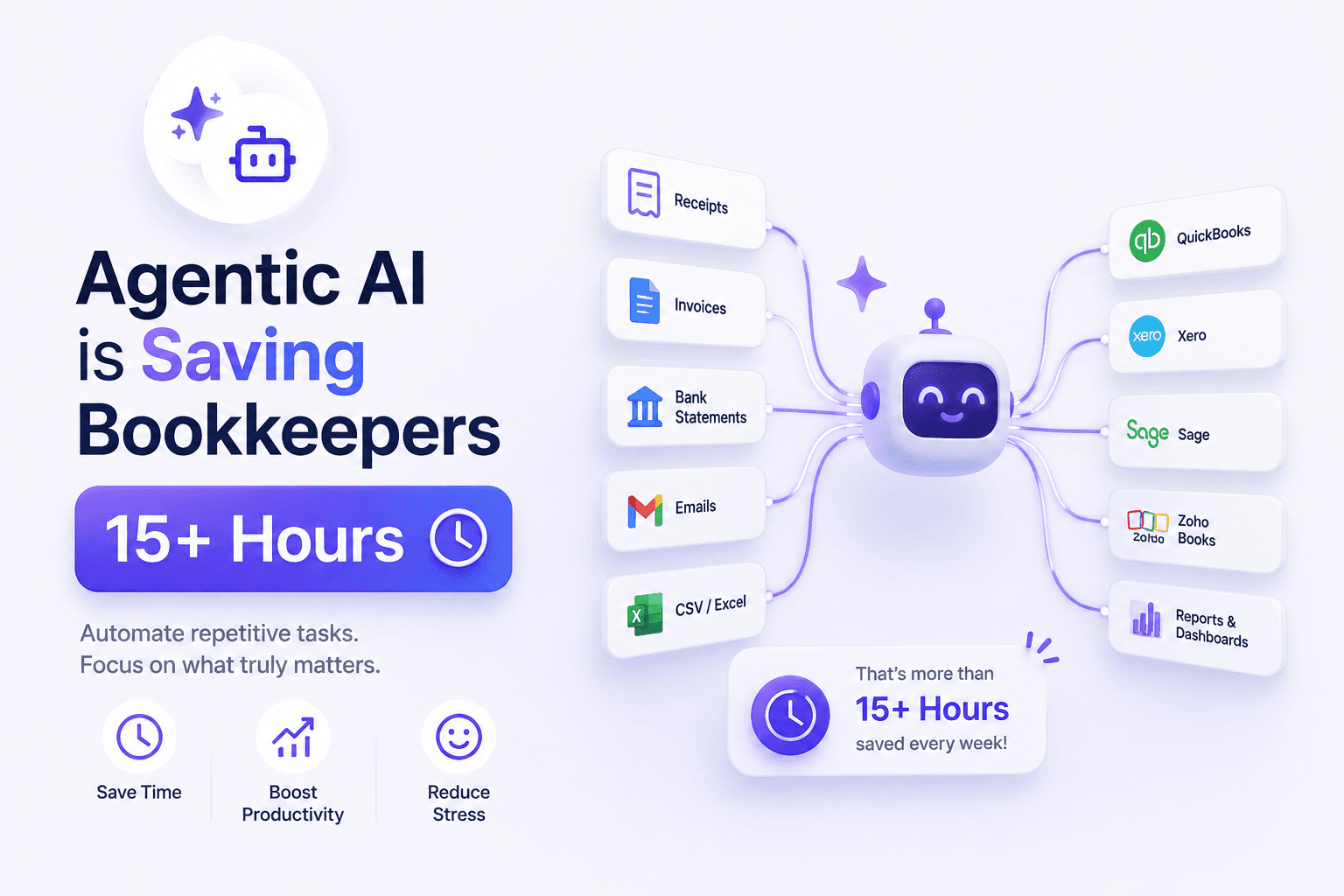
Suppose automation saves approximately 15 hours every week.
Those hours could become:
- Three one-hour strategy meetings.
- Weekly profitability reviews.
- Cash flow forecasting sessions.
- Budget planning workshops.
- Financial performance reviews.
- Technology consulting engagements.
These conversations deepen client relationships while generating significantly higher-value services.
Step 4: Build a Repeatable Monthly Advisory Process
Successful advisory firms follow structured client engagement rather than waiting for questions to arise.
A monthly framework might look like this:
Week 1
- Review automated bookkeeping.
- Resolve AI exceptions.
- Complete reconciliations.
Week 2
Prepare:
- Profit and Loss Statement
- Balance Sheet
- Cash Flow Report
- KPI Dashboard
Week 3
Analyze:
- Revenue trends
- Expense categories
- Profit margins
- Cash reserves
- Accounts receivable
- Budget variance
Week 4
Meet with the client to discuss:
- Financial performance.
- Business risks.
- Growth opportunities.
- Upcoming investments.
- Hiring plans.
- Pricing strategy.
- Operational improvements.
This recurring process positions the bookkeeper as an ongoing financial partner rather than a periodic service provider.
Step 5: Invest in Client Relationships
Automation improves efficiency.
Relationships build long-term businesses.
Clients rarely remain loyal because invoices were entered quickly.
They stay because they trust the advice they receive.
Virtual CFO conversations often include topics such as:
- Should we hire another employee?
- Can we afford to open another location?
- Which products are most profitable?
- Are our prices too low?
- Why has cash flow become unpredictable?
- Should we finance new equipment?
These discussions cannot be automated.
They rely on professional judgment, industry experience, and understanding each client's business goals.
The stronger these relationships become, the less likely clients are to compare bookkeeping firms solely on price.
Measuring Success After the Transition
Advisory-focused firms should monitor operational improvements alongside financial performance.
Useful metrics include:
| Metric | Why It Matters |
|---|---|
| Average invoice processing time | Measures automation efficiency |
| Manual correction rate | Tracks extraction accuracy |
| Number of advisory meetings | Indicates client engagement |
| Revenue per client | Reflects value-based pricing success |
| Monthly recurring revenue | Measures predictable income |
| Client retention rate | Indicates long-term satisfaction |
| Average onboarding time | Shows operational scalability |
| Documents processed per employee | Measures overall productivity |
Tracking these indicators helps demonstrate the return on investment from automation while identifying additional opportunities for improvement.
Common Challenges During the Transition
Every transformation brings new challenges.
Being aware of them allows firms to plan proactively.
Clients Expect Hourly Pricing
Some long-term clients may initially compare your new pricing with your previous hourly rates.
Focus the discussion on outcomes rather than time.
Highlight faster reporting, improved financial visibility, proactive advice, and ongoing support.
Internal Resistance
Team members accustomed to manual workflows may be hesitant to adopt AI-assisted processes.
Provide training and emphasize that automation reduces repetitive work rather than replacing professional expertise.
Learning New Skills
Moving into advisory work may require stronger communication, presentation, and analytical skills.
Invest in continuous professional development through financial planning, management accounting, and business consulting education.
Balancing Automation with Oversight
AI should streamline repetitive processes, but final financial decisions should always remain under professional supervision.
A human-in-the-loop approach ensures compliance, accuracy, and accountability.
Why BillsDeck Supports the Modern Bookkeeping Firm
Technology should do more than reduce keystrokes.
It should simplify operations, improve consistency, and create time for meaningful client work.
BillsDeck was built with this philosophy in mind.
With Agent Bill, bookkeeping firms can streamline document-intensive workflows through:
Intelligent Document Capture
Automatically collect invoices, receipts, supplier bills, and supporting financial documents from connected sources.
AI-Powered Data Extraction
Extract structured information from invoices, receipts, purchase documents, and financial records—even when layouts differ significantly.
Context-Aware Processing
Use historical supplier activity and previous bookkeeping decisions to recommend ledger mappings and improve consistency.
Multi-Client Workspace
Manage multiple businesses from a single dashboard without repeatedly switching between client environments.
Duplicate Detection
Identify duplicate invoices before they enter the accounting workflow, reducing the risk of duplicate payments and reconciliation issues.
Review Before Posting
Maintain complete control through approval workflows that allow bookkeepers to validate AI recommendations before exporting transactions.
This combination of automation and professional oversight enables firms to increase efficiency while maintaining the accuracy clients expect.
Frequently Asked Questions
What is a Virtual CFO?
A Virtual CFO provides strategic financial guidance to businesses on a part-time or outsourced basis. Services often include cash flow forecasting, budgeting, profitability analysis, financial planning, KPI reporting, and business strategy support.
Can bookkeepers become Virtual CFOs?
Yes.
Many experienced bookkeepers already possess a strong understanding of financial records and business operations. By combining bookkeeping expertise with financial analysis, communication skills, and advisory services, they can successfully transition into Virtual CFO roles.
Why is automation important for bookkeeping firms?
Automation reduces repetitive administrative work such as document collection, invoice extraction, and transaction preparation. This allows professionals to dedicate more time to financial analysis, reporting, and client advisory.
Does AI replace bookkeeping professionals?
No.
AI handles repetitive document-processing tasks while bookkeepers provide oversight, interpret financial information, ensure compliance, and deliver strategic recommendations that software cannot replace.
What is value-based pricing?
Value-based pricing charges clients according to the outcomes and expertise delivered rather than the number of hours worked. Examples include fixed monthly bookkeeping packages, financial advisory retainers, and Virtual CFO services.
How does BillsDeck help bookkeeping firms?
BillsDeck automates document capture, AI-powered data extraction, ledger recommendations, duplicate detection, and multi-client document management. This reduces administrative effort and creates more time for high-value advisory work.
Final Thoughts
The bookkeeping profession is evolving rapidly, but its core purpose remains unchanged: helping businesses maintain accurate financial records and make sound financial decisions.
What is changing is how that work is delivered.
Routine data entry, invoice extraction, and document organization are increasingly handled by intelligent automation. As these repetitive tasks become faster and more reliable, the greatest value bookkeepers can offer shifts toward interpretation, planning, and strategic guidance.
Firms that embrace this evolution will not compete on the number of hours they spend processing paperwork. They will compete on the quality of insights they deliver, the confidence they provide to business owners, and the measurable impact they have on business performance.
The transition from bookkeeper to Virtual CFO is not about replacing traditional bookkeeping. It is about building on that foundation to offer services that clients value even more.
By combining accounting expertise with modern automation, firms can increase capacity, strengthen client relationships, improve profitability, and create a business model designed for long-term growth.
Ready to Build Your Advisory Practice?
If your team is still spending valuable hours downloading invoices, entering data manually, correcting OCR errors, and managing documents across multiple client systems, now is the time to modernize your workflow.
With BillsDeck and Agent Bill, you can:
- Automate invoice and receipt collection.
- Extract structured financial data in seconds.
- Reduce manual bookkeeping effort.
- Manage multiple clients from one centralized workspace.
- Improve operational consistency across every engagement.
- Free up more than 15 hours each week for advisory services.
- Scale your bookkeeping firm without proportionally increasing headcount.
Start with a free BillsDeck account, explore the demo workspace, and experience how Agent Bill transforms document processing—giving your team more time to focus on strategic financial guidance that helps clients grow.
Continue Reading
You may also find these guides helpful:
- How to Import PDF Invoices into QuickBooks
- How to Import PDF Invoices into Wave Accounting
- GST Reconciliation: A Complete Guide
- Business Expense Categories Explained
- Types of Receipts in Accounting