Choosing an intelligent document processing platform in 2026 is no longer a niche IT decision—it is a finance operations decision. Accounts payable teams drowning in invoices, bookkeepers manually keying bank transactions, and controllers waiting on clean data for month-end close all feel the pain of unstructured documents. The market has responded with dozens of document AI vendors, each promising to turn PDFs into structured data with minimal human effort.
Three names come up repeatedly in finance and accounting conversations: Docsumo, Nanonets, and BillsDeck. All three use AI and OCR to extract data from documents. All three target business users who need more than a basic PDF reader. But their philosophies, feature depth, onboarding models, and ideal customers differ in ways that matter when you are committing budget, migrating workflows, and training staff.
This guide provides an honest document AI comparison of Docsumo vs Nanonets vs BillsDeck. We cover platform overviews, a detailed feature comparison table, finance team use cases, pricing and onboarding differences, when BillsDeck is the right fit, and practical migration tips. Whether you are evaluating your first IDP tool or reconsidering an existing vendor, this analysis is designed to help you make a confident decision.
For related comparisons, see our dedicated pages on Nanonets vs Docsumo, Docsumo alternatives, and Nanonets alternatives.
Key Takeaways
- Docsumo, Nanonets, and BillsDeck all extract structured data from documents, but they optimize for different buyer profiles and workflows.
- Docsumo emphasizes customizable document workflows and API-first integrations for operations teams.
- Nanonets focuses on no-code AI model training for teams that want to build custom extraction models.
- BillsDeck is purpose-built for finance and accounting teams processing invoices, receipts, and bank statements with direct bookkeeping integrations.
- Pricing models range from per-document to platform subscriptions—total cost depends on volume, document types, and required human-in-the-loop review.
- Migration from any platform to BillsDeck is straightforward when you standardize document types and map extraction fields to your chart of accounts.
What Is Intelligent Document Processing (IDP)?
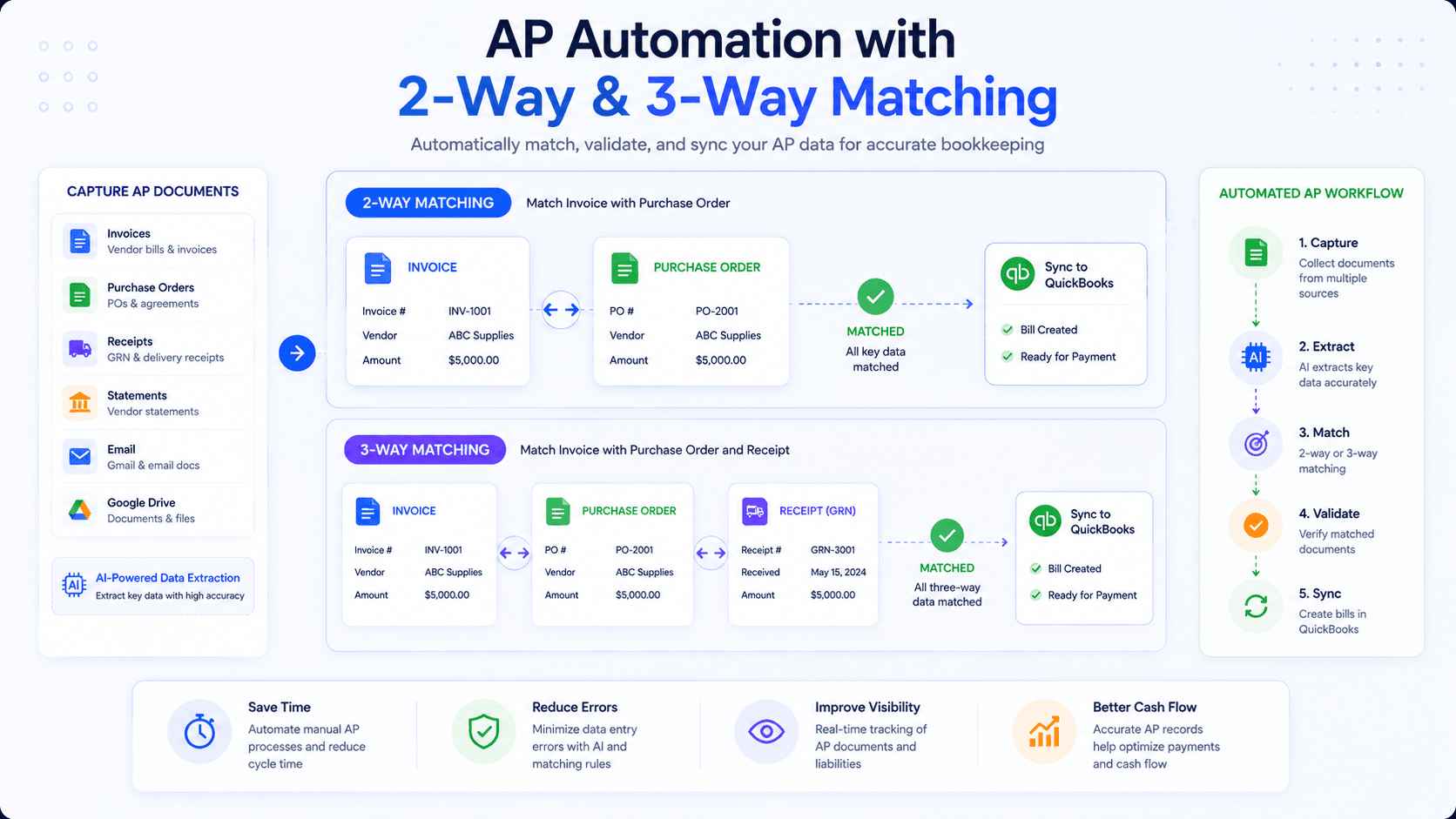
Before comparing platforms, it helps to define the category. Intelligent document processing combines OCR, machine learning, natural language processing, and workflow automation to convert unstructured documents—PDFs, images, scans, emails—into structured data that business systems can consume.
The IDP Pipeline
- Ingestion: Documents arrive via upload, email, API, or cloud storage sync
- Classification: The system identifies document type (invoice, receipt, bank statement, purchase order)
- Extraction: AI models pull fields like vendor name, date, line items, totals, and tax
- Validation: Rules and confidence scores flag uncertain extractions for review
- Integration: Structured data flows into ERP, accounting software, or data warehouses
Why Finance Teams Adopt IDP
Finance and accounting generate and receive some of the highest volumes of structured-yet-trapped data in any department. Invoices, receipts, bank statements, credit card statements, remittance advices, and expense reports all contain fields that must land accurately in the general ledger. Manual entry is slow, expensive, and error-prone. IDP software automates the extraction layer so accountants can focus on review, reconciliation, and advisory work rather than typing.
The global IDP market has matured significantly. Early tools required extensive custom training for every document layout. Modern platforms—including Docsumo, Nanonets, and BillsDeck—ship with pre-trained models for common financial documents while still allowing customization where needed.
Platform Overview: Docsumo
Docsumo is a document AI platform that positions itself as a flexible data extraction and workflow automation tool for operations-heavy teams. It is commonly evaluated by companies processing high volumes of varied document types across industries—not exclusively finance.
Core Strengths
- Custom workflow builder: Configure extraction pipelines with validation rules, approval steps, and export destinations
- API-first architecture: Strong fit for engineering teams embedding extraction into proprietary products or internal tools
- Multi-industry templates: Pre-built models for invoices, utility bills, insurance documents, and more
- Human-in-the-loop review: Review queues for low-confidence extractions with annotation tools
Typical Users
- Operations teams at mid-market companies
- Product teams building document processing into their own SaaS offerings
- Organizations with diverse document types beyond standard finance documents
Considerations
Docsumo is powerful but generalist. Finance teams may need additional configuration to align extracted fields with accounting-specific conventions like GL codes, tax jurisdictions, and multi-entity chart of accounts structures. Onboarding can involve more setup time compared to finance-native platforms.
If you are specifically evaluating Docsumo against other options, our Docsumo alternative comparison page covers additional context.
Platform Overview: Nanonets
Nanonets is a no-code AI platform that lets teams train custom extraction models without writing code. Its headline promise: upload sample documents, annotate fields, and deploy a model that learns your layouts.
Core Strengths
- No-code model training: Business users can create and retrain extraction models through a visual interface
- Broad document support: Handles invoices, receipts, forms, IDs, and custom document types
- Workflow automation: Rules-based routing, approvals, and integrations with Zapier, QuickBooks, and other tools
- Rapid prototyping: Teams can test extraction on new document types quickly without engineering sprints
Typical Users
- Teams with highly variable or proprietary document formats not covered by off-the-shelf models
- Startups and growth-stage companies experimenting with automation before committing to enterprise contracts
- Operations managers who want self-service control over model training
Considerations
Nanonets' flexibility is also its complexity. Training accurate models requires quality annotated samples—often dozens per document type. Model performance can degrade when vendors change invoice layouts unless someone retrains. Finance teams focused on standard invoices, receipts, and bank statements may find the training overhead unnecessary when pre-built finance models already handle their documents.
See our Nanonets alternative comparison for teams exploring other options.
Platform Overview: BillsDeck
BillsDeck is a document AI platform built specifically for finance and accounting workflows. Rather than offering a general-purpose extraction toolkit, BillsDeck optimizes for the documents bookkeepers and accountants process daily: invoices, receipts, bank statements, credit card statements, and purchase orders.
Core Strengths
- Finance-native extraction: Pre-trained models for accounting document types with field mappings aligned to bookkeeping conventions
- Bank statement and receipt focus: Industry-leading accuracy on bank statement PDF to CSV conversion and receipt OCR
- Accounting integrations: Direct workflows for QuickBooks, Xero, and Sage—not just generic CSV export
- Inbox-style review: Finance-friendly UI for reviewing, categorizing, and approving extracted transactions
- Batch processing: Month-end statement processing and bulk invoice uploads designed for close workflows
Typical Users
- Bookkeeping and accounting firms processing client documents
- Small and mid-size businesses managing expenses and bank reconciliation
- Finance teams replacing manual data entry without hiring developers
- Companies migrating from generalist IDP tools that required excessive configuration
Considerations
BillsDeck is optimized for finance documents. Teams needing extraction for legal contracts, medical forms, or highly specialized non-financial documents may need a generalist platform alongside BillsDeck or instead of it. For core AP, expense, and bank reconciliation workflows, that specialization is a strength, not a limitation.
Explore the full BillsDeck feature set and invoice OCR capabilities for detailed capability information.
Feature Comparison Table
The following table summarizes how Docsumo, Nanonets, and BillsDeck compare across capabilities finance teams care about most.
| Feature | Docsumo | Nanonets | BillsDeck |
|---|---|---|---|
| Primary focus | General document workflows | No-code custom model training | Finance & accounting documents |
| Invoice extraction | Yes (template + custom) | Yes (train your own) | Yes (pre-built, finance-tuned) |
| Receipt OCR | Yes | Yes | Yes (99%+ accuracy focus) |
| Bank statement extraction | Yes (configurable) | Yes (requires training) | Yes (core product strength) |
| Credit card statements | Yes | Yes | Yes |
| Pre-built finance models | Partial | Limited (train required) | Extensive |
| No-code setup | Moderate | High | High |
| Custom model training | Yes | Core feature | Not required for standard docs |
| API access | Strong | Yes | Yes |
| QuickBooks integration | Via API/Zapier | Yes | Native workflow |
| Xero integration | Via API/Zapier | Yes | Native workflow |
| Sage integration | Via API/Zapier | Limited | Yes |
| Human review UI | Yes | Yes | Finance-optimized inbox |
| Batch upload | Yes | Yes | Yes (month-end focused) |
| CSV/Excel export | Yes | Yes | Yes |
| Auto-categorization | Configurable rules | Configurable rules | AI categorization for expenses |
| Bank reconciliation support | Manual setup | Manual setup | Built into workflow |
| Multi-entity support | Yes | Yes | Yes |
| Onboarding time | Days to weeks | Days (with training data) | Hours to days |
| Ideal team size | Mid-market to enterprise | SMB to mid-market | SMB to mid-market firms |
| Technical skill required | Moderate–high | Low–moderate | Low |
| Free trial | Available | Available | Available |
This IDP software comparison is directional, not a scorecard. The best platform depends on your document mix, technical resources, and integration requirements.
Finance Team Use Cases
Different finance workflows stress different platform capabilities. Here is how each tool fits common scenarios.
Accounts Payable: Invoice Processing
The workflow: Vendors email PDF invoices. AP must extract vendor, invoice number, date, line items, tax, and total, then route for approval and post to the ERP.
- Docsumo: Handles invoice extraction well with configurable validation rules. Strong when AP is part of a broader document operation that also processes non-financial docs. Requires setup to map fields to your ERP.
- Nanonets: Excellent when your invoices come in highly varied custom formats—such as construction, logistics, or industry-specific layouts. Train a model on your samples for best results.
- BillsDeck: Optimized for standard and semi-standard invoices with pre-built extraction and invoice OCR tuned for accounting fields. Minimal setup; extracted data maps naturally to QuickBooks and Xero bill creation.
Best fit: BillsDeck for standard AP with accounting integration priorities. Nanonets for highly custom invoice layouts. Docsumo for AP as part of a multi-document operations platform.
Expense Management: Receipt Capture
The workflow: Employees submit receipt photos. Finance must extract merchant, date, amount, tax, and category for reimbursement and bookkeeping.
- Docsumo: Capable receipt extraction with workflow customization. May require template configuration for receipt-specific fields.
- Nanonets: Train a receipt model if your receipts are unusual (multi-language, handwritten, non-standard). Standard receipts work with less training.
- BillsDeck: Receipt scanning is a core capability with mobile capture, AI categorization, and direct expense entry into accounting platforms.
Best fit: BillsDeck for bookkeeping firms and SMBs prioritizing receipt-to-ledger automation.
Bank Reconciliation: Statement Processing
The workflow: Download monthly bank and credit card PDF statements. Extract transactions to CSV or directly into accounting software. Reconcile against the ledger.
- Docsumo: Can extract bank statement tables with proper template configuration. Better suited to teams already using Docsumo for other document types.
- Nanonets: Possible with custom model training on your bank's statement format. Performance varies by bank until sufficient training data exists.
- BillsDeck: Bank statement extraction is a flagship feature. Handles multi-page statements, scanned PDFs, and varied bank layouts with pre-built models. CSV export and direct categorization support reconciliation workflows.
Best fit: BillsDeck for teams where statement processing volume and accuracy are primary decision factors.
Bookkeeping Firm: Multi-Client Document Processing
The workflow: Process invoices, receipts, and statements for dozens of clients across different banks, vendors, and accounting systems.
- Docsumo: Scales with API and workflow automation. Firms need technical setup or dedicated ops staff to maintain configurations.
- Nanonets: Flexible per-client model training is powerful but time-intensive at scale.
- BillsDeck: Built for bookkeeping workflows—client workspaces, batch processing, accounting platform integrations, and finance-native review queues reduce per-client configuration overhead.
Best fit: BillsDeck for firms prioritizing client throughput and accounting integration over custom model development.
Embedded Document AI in Your Product
The workflow: Your SaaS product needs document extraction as a feature—perhaps for your customers' invoices or forms.
- Docsumo: Strong API-first positioning. Designed for embedding extraction into products.
- Nanonets: API available; no-code training helps product teams iterate on models.
- BillsDeck: API available but optimized for finance operations teams rather than ISVs embedding extraction.
Best fit: Docsumo or Nanonets for product embedding. BillsDeck for finance operations.
Pricing and Onboarding Differences
Pricing in the document AI market is notoriously variable. List prices are rarely published in detail, and total cost depends on document volume, features, and support tier. Here is how the three platforms generally structure their commercial models.
Docsumo Pricing Model
Docsumo typically offers tiered plans based on document volume and feature access. Enterprise contracts include custom pricing with SLA guarantees, dedicated support, and advanced workflow features. Onboarding often involves a solutions engineer helping configure extraction templates and integrations. Expect a longer ramp-up—days to weeks—before production processing begins.
Cost drivers:
- Monthly document volume
- Number of document types and custom workflows
- API call volume for embedded use cases
- Human review seats
Nanonets Pricing Model
Nanonets offers per-model and per-document pricing tiers, with a free tier for experimentation. Paid plans scale with processing volume and number of active models. Because model training is self-service, onboarding can be fast if you have annotated samples ready—but gathering training data adds hidden time cost.
Cost drivers:
- Number of documents processed per month
- Number of custom models deployed
- Workflow automation steps
- Integration connectors
BillsDeck Pricing Model
BillsDeck offers subscription plans aligned with finance team sizes—from solo bookkeepers to growing firms processing high monthly volumes. Pricing is oriented around document processing capacity rather than per-model fees. Onboarding is streamlined: upload a document, review extraction, connect accounting software. Most teams are productive within hours to a few days.
Cost drivers:
- Monthly document/transaction volume
- Number of connected accounting entities
- Team member seats for review and approval
- Premium features like auto-categorization and batch statement processing
Total Cost of Ownership Beyond Subscription Fees
When comparing docsumo vs nanonets vs billsdeck on price alone, include:
- Implementation labor: Developer time for API integrations, workflow configuration, or model training
- Ongoing maintenance: Retraining models when document layouts change, updating validation rules
- Error correction labor: Human review hours driven by extraction accuracy
- Opportunity cost: Days to close books while waiting for clean data
A lower per-document price with 90% accuracy can cost more than a slightly higher price with 98% accuracy when you factor in review labor.
Accuracy and Reliability Comparison
Extraction accuracy is the metric that matters most in production. Marketing claims vary; real-world performance depends on document quality and type.
Native Digital PDFs
All three platforms perform well on clean, digitally generated PDFs. Differences are marginal for standard single-page invoices.
Scanned and Photographed Documents
BillsDeck and Docsumo both invest in financial OCR pipelines. Nanonets performance depends heavily on training data quality. For receipt photos and scanned statements, finance-tuned models (BillsDeck) typically outperform general models without custom training (Nanonets).
Bank Statements
This is where platform specialization shows. BillsDeck's pre-trained bank statement models handle multi-page layouts, varied column structures, and running balances with minimal configuration. Docsumo can achieve similar results with template setup. Nanonets requires training samples for each bank format unless layouts happen to match existing community models.
Invoices with Complex Line Items
Docsumo and Nanonets excel when line item tables are non-standard—nested categories, multi-page item lists, or industry-specific fields. BillsDeck handles standard line item extraction well and continues improving on complex tables. For exotic invoice formats, Nanonets' custom training may edge out pre-built models.
Integration and Ecosystem
Docsumo Integrations
Docsumo connects via API, webhooks, Zapier, and direct integrations with various ERP and storage systems. Its strength is flexibility—finance teams with engineering support can pipe data anywhere. Without engineering support, integration setup may require professional services.
Nanonets Integrations
Nanonets offers native connectors for QuickBooks, Google Drive, Dropbox, and workflow tools like Zapier and Make. The no-code philosophy extends to integration setup. Accounting integrations exist but may not be as deeply embedded into bookkeeping workflows as finance-native platforms.
BillsDeck Integrations
BillsDeck prioritizes accounting platform depth over connector breadth. QuickBooks Online, Xero, and Sage integrations are first-class citizens—extracted transactions flow into the right modules (bills, expenses, bank feeds) rather than requiring manual CSV import. API access supports custom workflows for firms with proprietary tools.
When to Choose BillsDeck
BillsDeck is the right choice when your priorities align with finance-native automation:
Choose BillsDeck If You:
- Process invoices, receipts, and bank statements as your primary document types
- Need pre-built extraction without training custom models
- Want direct QuickBooks, Xero, or Sage integration—not just CSV export
- Are a bookkeeping firm managing multiple client entities
- Prioritize bank statement PDF to CSV conversion accuracy
- Have a small finance team without dedicated engineering resources
- Want an inbox-style review experience designed for accountants
- Are migrating from manual data entry or spreadsheet-based workflows
Choose Docsumo Instead If You:
- Need a general-purpose document platform spanning finance and non-finance use cases
- Have engineering resources to build API-driven custom workflows
- Are embedding document extraction into your own software product
- Require highly customized validation and multi-step approval pipelines across diverse document types
Choose Nanonets Instead If You:
- Have highly proprietary or unusual document formats not covered by standard models
- Want to train and own custom extraction models without writing code
- Are experimenting with document AI and need a flexible sandbox
- Have staff available to annotate training samples and maintain models over time
Many organizations ultimately use different tools for different jobs—a generalist platform for operations and BillsDeck for finance. But for teams whose document volume is predominantly financial, consolidating on BillsDeck reduces complexity and total cost.
Migration Tips: Moving to BillsDeck
If you are transitioning from Docsumo, Nanonets, or manual processes to BillsDeck, follow these steps for a smooth migration.
1. Audit Your Current Document Mix
Catalog document types, monthly volumes, and extraction fields for each. BillsDeck handles invoices, receipts, bank statements, credit card statements, and purchase orders natively. Flag any non-standard documents that may need continued processing elsewhere.
2. Map Extraction Fields to Your Chart of Accounts
Document how extracted fields map to GL codes, tax rates, and entity structures. BillsDeck's categorization engine uses this mapping for auto-categorization. Export field mappings from your current platform as a reference.
3. Run Parallel Processing for One Month
Process the same documents through both your old platform and BillsDeck during a trial month. Compare extraction accuracy, review time, and integration output. Pay special attention to bank statements and receipts where accuracy differences are most visible.
4. Connect Accounting Software Early
Link QuickBooks, Xero, or Sage during the trial—not after migration. Integration issues are easier to resolve before you depend on the pipeline for month-end close.
5. Train Your Team on the Review Inbox
BillsDeck's review workflow may differ from Docsumo's task queues or Nanonets' verification screens. Schedule a one-hour team walkthrough covering upload, review, correction, approval, and sync.
6. Migrate Historical Data Selectively
You do not need to re-process years of archived documents. Migrate open items, current-period documents, and any in-flight approvals. Keep historical data in your old platform or archive storage for audit reference.
7. Decommission Old Workflows Gradually
Maintain read-only access to your previous platform for 60–90 days as a safety net. Cancel subscriptions once BillsDeck handles full production volume reliably.
8. Provide Feedback for Model Improvement
BillsDeck improves models continuously. Flag extraction errors during review—corrections help the system learn your specific vendors and bank formats.
Security and Compliance Comparison
All three platforms handle sensitive business documents. Evaluate each on:
| Consideration | What to Ask |
|---|---|
| Data encryption | Is data encrypted in transit (TLS) and at rest (AES-256)? |
| Data retention | How long are documents stored? Can you set auto-deletion? |
| Compliance certifications | SOC 2 Type II, GDPR, HIPAA (if applicable)? |
| Data residency | Can you choose processing region? |
| Access controls | Role-based permissions, SSO, audit logs? |
| Subprocessor transparency | Who processes data behind the scenes? |
Finance teams should request security documentation during evaluation—not after contract signature. BillsDeck, Docsumo, and Nanonets all address enterprise security requirements, but specifics vary by plan tier.
Performance at Scale
Low Volume (Under 500 Documents/Month)
All three platforms handle this comfortably. BillsDeck offers the fastest time-to-value for finance documents. Nanonets offers experimentation flexibility. Docsumo may feel heavyweight for this volume unless you need its broader workflow features.
Medium Volume (500–5,000 Documents/Month)
This is the sweet spot for bookkeeping firms and growing SMBs. BillsDeck's batch processing and accounting integrations deliver efficiency gains. Nanonets model maintenance overhead may increase unless document formats are stable. Docsumo's workflow automation pays off if document types are diverse.
High Volume (5,000+ Documents/Month)
Enterprise pricing and dedicated support become important. Docsumo's API-first architecture scales well for embedded or multi-department deployments. BillsDeck scales for finance-centric high volume—particularly statement and receipt processing. Nanonets requires disciplined model governance to maintain accuracy across thousands of documents.
Customer Support and Community
Docsumo
Enterprise customers receive dedicated account management and implementation support. Documentation and API references are thorough. Best experience on paid tiers with assigned support contacts.
Nanonets
Active online community, documentation for model training, and standard support channels. Responsive for technical questions about model performance. Finance-specific best practices may require self-discovery.
BillsDeck
Finance-focused support team understands bookkeeping workflows. Onboarding assistance for accounting integrations. Help content oriented toward accountants and bookkeepers rather than developers.
Frequently Asked Questions
Is Docsumo or Nanonets better for invoice processing?
Both handle invoices well. Docsumo suits teams wanting configurable workflows and API integration. Nanonets suits teams with unusual invoice formats willing to train custom models. For standard invoices with accounting integration, BillsDeck offers faster setup and finance-native field extraction. See our invoice OCR page for BillsDeck-specific capabilities.
Can I use BillsDeck alongside Docsumo or Nanonets?
Yes. Some organizations use a generalist platform for non-financial documents and BillsDeck for invoices, receipts, and bank statements. Evaluate whether dual subscriptions cost less than the accuracy and efficiency gains in finance workflows.
How long does it take to switch from Nanonets to BillsDeck?
Most finance teams are processing production documents within one to two weeks. Parallel testing during one billing cycle is recommended. Custom Nanonets models do not transfer directly, but BillsDeck's pre-built finance models typically cover the same document types without retraining.
Does BillsDeck require technical skills to set up?
No. BillsDeck is designed for bookkeepers, accountants, and finance managers. Upload documents, review extractions, and connect accounting software through a visual interface. API access is available for teams wanting programmatic integration but is not required.
Which platform has the best bank statement extraction?
BillsDeck specializes in bank statement PDF to CSV conversion with pre-trained models for varied bank layouts. Docsumo achieves strong results with template configuration. Nanonets requires model training per bank format. For statement-heavy workflows, BillsDeck is typically the strongest out-of-box option.
How do pricing models compare?
Docsumo and Nanonets generally price by document volume and feature tier, with enterprise custom quotes. Nanonets adds cost per custom model. BillsDeck prices on subscription tiers aligned with finance team size and processing volume. Request quotes from all three based on your actual monthly document count for accurate comparison.
What is the main difference between IDP and basic OCR?
Basic OCR converts images to text. Intelligent document processing understands document structure—identifying that a number is an invoice total, not a phone number—and exports structured fields. All three platforms provide IDP, not just OCR.
Is Nanonets better than Docsumo?
Neither is universally better. Nanonets excels at no-code custom model training. Docsumo excels at configurable enterprise workflows and API embedding. The better choice depends on whether you prioritize model flexibility (Nanonets) or workflow automation breadth (Docsumo). For finance-specific workflows, BillsDeck may outperform both without custom training.
Can BillsDeck replace my entire Docsumo deployment?
If your Docsumo deployment processes primarily financial documents, BillsDeck can likely replace it with faster onboarding and better accounting integration. If Docsumo handles diverse non-financial document types—insurance forms, utility bills, customs documents—you may keep Docsumo for those and use BillsDeck for finance.
Where can I find more detailed head-to-head comparisons?
Visit our comparison pages: Nanonets vs Docsumo, Docsumo alternatives, and Nanonets alternatives.
Conclusion
The docsumo vs nanonets vs billsdeck decision comes down to what your team processes, who operates the tool, and where extracted data needs to land. Docsumo is a capable generalist with API strength and workflow flexibility. Nanonets empowers teams to train custom models without code. BillsDeck delivers finance-native intelligent document processing with the fastest path from document upload to reconciled books.
For finance and accounting teams—bookkeepers, controllers, AP clerks, and firm owners—the specialization equation usually favors a platform built for their documents and integrations. Pre-trained invoice, receipt, and bank statement models, combined with QuickBooks and Xero connectivity, eliminate weeks of configuration that generalist platforms require.
Evaluate all three with a structured trial: run your actual documents through each platform, measure extraction accuracy, time the review process, and test accounting integration end to end. Use the feature comparison table in this guide as a checklist. Include total cost of ownership, not just subscription price.
If your document world is primarily financial, start with BillsDeck. Explore the full feature overview, test invoice OCR, and compare against alternatives on our Nanonets vs Docsumo page. The right document AI platform is the one that makes your month-end close faster, your data cleaner, and your team freer to do work that actually requires human judgment.