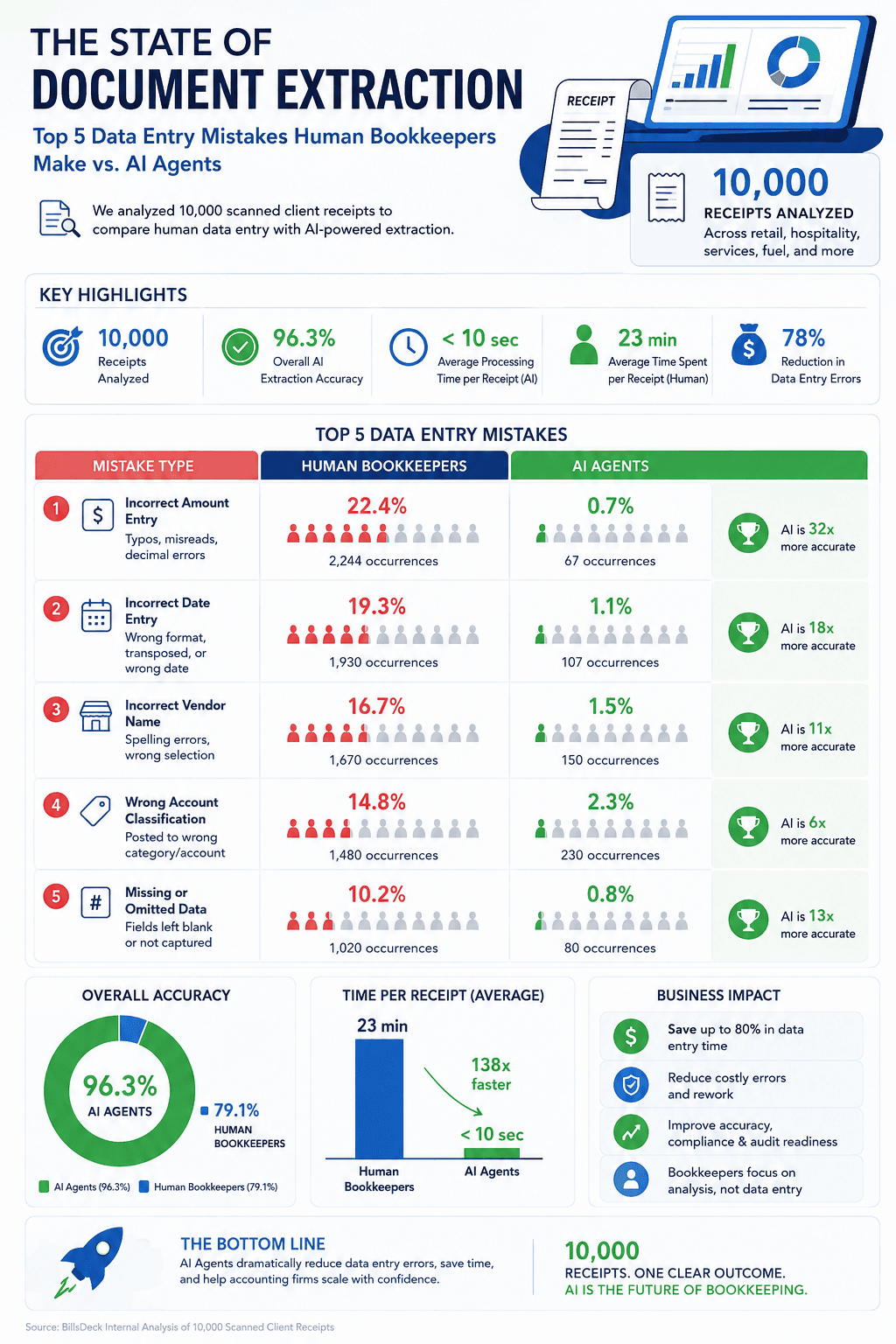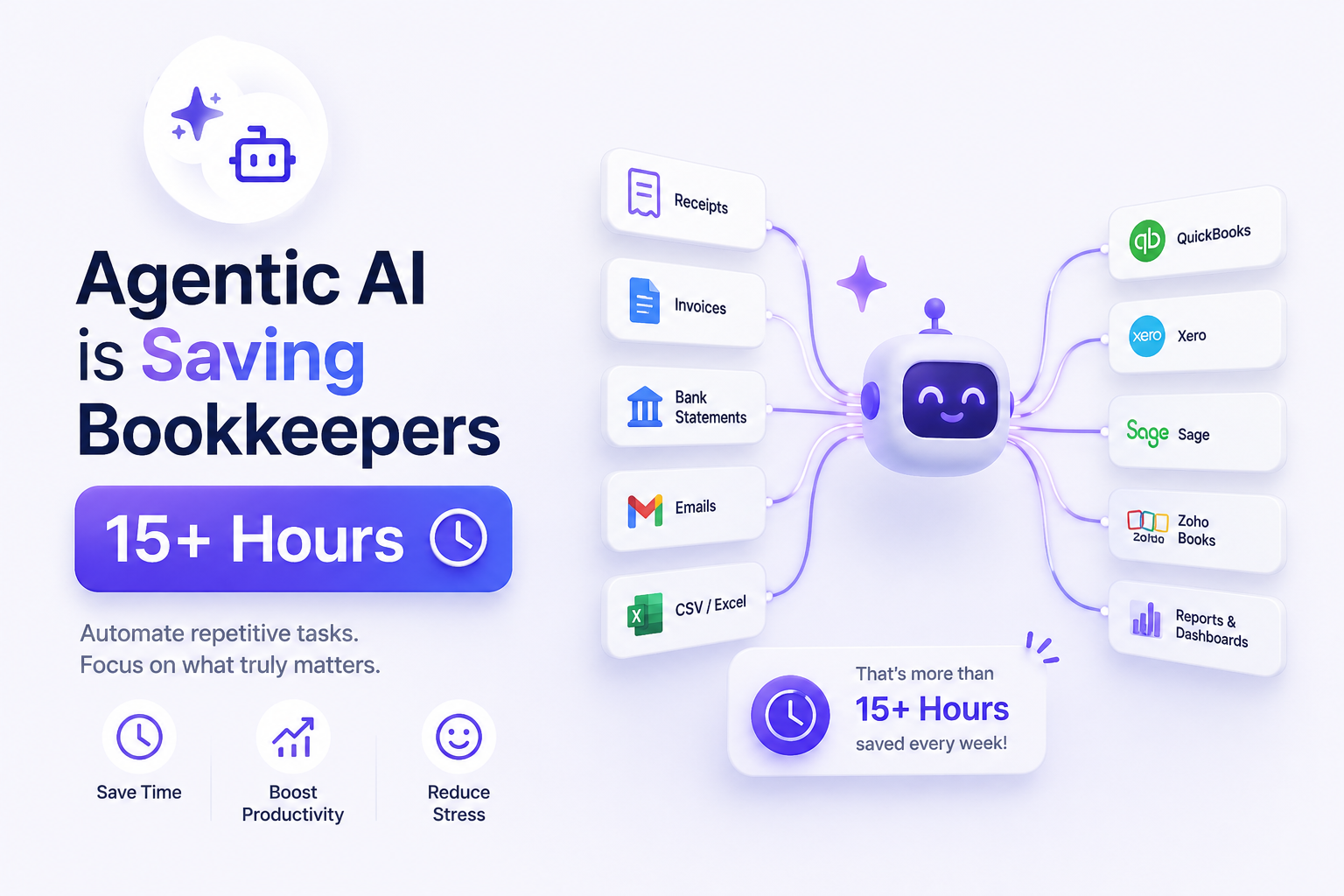
Image Source: https://billsdeck.com
Table of Contents
- Introduction
- Why Traditional OCR Has Reached Its Limits
- What Is Agentic AI?
- Agentic AI vs Traditional OCR
- Why Context Matters More Than Text
- Comparison Table
- What's Next
Introduction
For years, bookkeeping firms have faced a familiar challenge.
Winning new clients is exciting, but every additional client also brings another stream of invoices, receipts, supplier statements, bank documents, purchase orders, and expense reports. Eventually, growth becomes constrained—not because firms cannot attract business, but because processing financial documents consumes more hours than their teams can handle.
Historically, firms solved this problem by hiring additional staff dedicated to manual data entry.
Then came OCR.
Optical Character Recognition promised to eliminate repetitive typing by converting images into editable text. While OCR significantly reduced manual work, it introduced a different challenge: extracted text still required human interpretation.
Bookkeepers found themselves asking questions like:
- Is this actually the invoice number?
- Why did the software mistake the subtotal for the total?
- Which supplier does this belong to?
- Which ledger account should this expense use?
- Why did the extraction fail after the supplier redesigned their invoice?
Instead of replacing manual work, OCR shifted the workload from typing information to correcting inaccurate extractions.
As bookkeeping firms continued growing, these small corrections accumulated into hours every week.
The industry is now entering a new phase.
Rather than relying solely on software that reads text, modern accounting platforms are adopting Agentic AI—intelligent systems capable of understanding financial documents, making contextual decisions, and continuously improving from previous transactions.
Instead of simply extracting words from a PDF, these AI agents understand what those words represent.
For bookkeepers, this shift changes everything.
Instead of spending evenings reviewing invoices line by line, firms can automate document intake, classify expenses, map ledger accounts, and process transactions across dozens of clients from a single workspace.
The result isn't just faster bookkeeping.
It fundamentally changes how bookkeeping firms scale.
Why Traditional OCR Has Reached Its Limits
OCR technology has existed for decades and remains an important component of document digitization.
However, bookkeeping presents challenges that extend far beyond converting images into text.
Financial documents are rarely standardized.
One supplier places the invoice number at the top right.
Another uses the bottom left.
Some vendors call it Invoice Number, while others label it Reference, Bill Number, Document ID, or simply No.
Human accountants recognize these differences almost instantly.
Traditional OCR does not.
Instead, it follows predefined rules such as:
- Fixed document templates
- Pattern matching
- Coordinates
- Keyword searches
- Regular expressions (Regex)
These methods work reasonably well until something changes.
Even minor layout adjustments can disrupt extraction accuracy.
For bookkeeping firms managing hundreds of vendors across multiple clients, maintaining OCR templates becomes an ongoing operational burden.
Common problems include:
Layout Changes
A supplier redesigns their invoice.
Previously accurate templates suddenly fail.
Someone must rebuild extraction rules manually.
Low-Quality Documents
Clients upload:
- mobile photos
- scanned copies
- folded receipts
- blurry PDFs
- compressed email attachments
OCR accuracy drops dramatically as document quality declines.
Missing Context
OCR identifies text.
It does not understand meaning.
For example:
Amazon Marketplace

$129.99
OCR extracts the words successfully.
But it cannot determine:
- Is this office equipment?
- Software?
- Marketing expense?
- Inventory?
- Client reimbursement?
- Capital expenditure?
Only a human—or an intelligent AI agent—can make that decision based on business context.
No Learning Capability
Traditional OCR repeats identical mistakes indefinitely.
If it incorrectly maps a supplier once, it will likely repeat the same error tomorrow.
It does not learn from user corrections.
Every correction remains manual.
The Hidden Cost of "Almost Accurate"
Many bookkeeping firms report OCR accuracy exceeding 90%.
At first glance, that appears impressive.
However, consider a firm processing:
- 500 invoices weekly
- 40 extracted fields per invoice
That's over 20,000 extracted values every week.
Even a modest 5% error rate results in:
1,000 fields requiring manual review.
Those thousand corrections consume valuable hours that experienced bookkeepers could instead spend on:
- advisory services
- financial analysis
- client communication
- forecasting
- business development
The true cost isn't simply incorrect data.
It's the opportunity cost of highly skilled professionals performing repetitive validation work.
What Is Agentic AI?
Agentic AI represents the next evolution of business automation.
Instead of functioning as a passive extraction tool, an AI agent actively works toward completing an objective.
Think of it as the difference between:
OCR
"Here's the text I found."
versus
Agentic AI
"I've read the invoice, identified the supplier, extracted the financial information, matched the client, selected the correct ledger account based on previous transactions, checked for duplicates, validated totals, and prepared the transaction for approval."
The difference is enormous.
Modern AI agents combine several capabilities simultaneously:
- Document understanding
- Natural language reasoning
- Historical transaction learning
- Decision making
- Confidence scoring
- Continuous improvement
Rather than requiring hundreds of invoice templates, Agentic AI analyzes the document as a human accountant would.
It understands relationships between different pieces of information instead of simply recognizing isolated text.
Meet Agent Bill
At BillsDeck, this philosophy powers Agent Bill.
Instead of asking users to create templates for every supplier invoice, Agent Bill is designed to understand documents regardless of format.
Whether a client uploads:
- supplier invoices
- receipts
- utility bills
- purchase invoices
- expense reports
- vendor statements
Agent Bill identifies:
- supplier name
- invoice number
- invoice date
- due date
- currency
- tax information
- totals
- line items
- payment details
More importantly, it understands how those values relate to each other before preparing structured accounting data.
This contextual understanding significantly reduces manual verification while improving consistency across client accounts.
Agentic AI vs Traditional OCR
Although both technologies process documents, their capabilities differ substantially.
| Feature | Traditional OCR | Agentic AI |
|---|---|---|
| Reads text | Yes | Yes |
| Understands document context | No | Yes |
| Learns from previous corrections | No | Yes |
| Handles unfamiliar layouts | Limited | Excellent |
| Predicts ledger accounts | No | Yes |
| Identifies duplicate invoices | Limited | Yes |
| Extracts line items intelligently | Template-dependent | Context-aware |
| Works across multiple clients | Manual configuration | Native intelligence |
| Requires template maintenance | Frequent | Minimal |
| Continuous improvement | No | Yes |
Why Context Matters More Than Text
Imagine receiving two invoices from different suppliers.
Both contain:
$299.00
Traditional OCR simply extracts the value.
Agentic AI asks questions such as:
- Which client uploaded this?
- Which supplier issued it?
- Has this vendor appeared before?
- Which expense category was previously used?
- Is GST applicable?
- Does the total match line items?
- Is this likely a duplicate submission?
- Does this invoice already exist inside the accounting system?
These decisions are based on context rather than text recognition alone.
That distinction is precisely why modern bookkeeping automation is moving beyond OCR.
Instead of automating data extraction, Agentic AI automates decision-making—while still allowing bookkeepers to review and approve transactions before posting.
The Shift From Automation to Intelligence
For many years, accounting automation focused on reducing typing.
Today, the focus has shifted toward reducing decision fatigue.
Every manual choice—selecting a supplier, assigning an account code, verifying totals, checking duplicates—consumes attention.
Individually, these tasks seem small.
Across hundreds of documents every week, they become one of the largest operational bottlenecks for bookkeeping firms.
Agentic AI addresses this challenge by handling the repetitive decisions that previously required constant human intervention.
Rather than replacing professional judgment, it augments it, allowing bookkeepers to spend more time on reviewing exceptions, advising clients, and delivering higher-value services.
How Bookkeepers Save 15+ Hours Every Week with Agentic AI
The promise of automation has always been about saving time. Yet many bookkeeping firms discovered that replacing manual data entry with OCR simply shifted the workload rather than eliminating it.
Instead of typing invoice details into accounting software, staff spent their time validating extracted fields, correcting supplier names, fixing dates, and assigning ledger accounts. While these tasks were faster than full manual entry, they still required attention for every document.
Agentic AI changes this workflow by automating entire processes rather than isolated tasks.
Instead of asking, "What text is on this invoice?" it asks, "What needs to happen next to complete this bookkeeping task?"
Across hundreds or even thousands of documents each month, these incremental improvements compound into significant time savings.
For many bookkeeping firms, reclaiming 15 or more hours every week isn't the result of one feature. It's the combined impact of intelligent document collection, contextual data extraction, ledger prediction, and centralized client management.
1. Automated Document Intake Instead of Manual Collection
Before invoices can be processed, they first need to arrive.
Surprisingly, this remains one of the biggest bottlenecks for many bookkeeping firms.
Typical document collection looks something like this:
- Clients email invoices throughout the month.
- Some upload PDFs to shared folders.
- Others send photos through messaging apps.
- Paper receipts arrive at month-end.
- Missing documents require follow-up emails.
By the time bookkeeping begins, valuable time has already been spent gathering information instead of processing it.
The Traditional Workflow
A typical bookkeeper might spend part of every morning:
- Downloading email attachments
- Renaming files
- Organizing folders
- Removing duplicate uploads
- Requesting missing invoices
- Uploading documents into bookkeeping software
These repetitive administrative tasks provide little value to clients, yet they consume hours every week.
Agentic AI Creates an Automated Intake Pipeline
Modern bookkeeping platforms can monitor dedicated email inboxes and automatically collect incoming financial documents.
Instead of manually downloading every attachment, documents are immediately routed into the appropriate client workspace.
For example:
Supplier sends invoice

↓

Invoice arrives in Gmail

↓

[**BillsDeck**](https://www.billsdeck.com/) detects the attachment

↓

Agent Bill identifies the client

↓

Invoice is categorized

↓

Data extraction begins automatically

↓

Bookkeeper reviews only if needed
This removes several manual steps before bookkeeping even starts.
Benefits of Automated Intake
- No downloading attachments manually
- No duplicate uploads
- Faster processing
- Consistent document organization
- Reduced client follow-ups
- Improved month-end readiness
Native Gmail Integration
Email remains the primary way businesses exchange invoices.
Rather than expecting clients to learn new upload portals, Agentic AI works with existing communication channels.
When integrated with Gmail, BillsDeck can automatically detect:
- PDF invoices
- Supplier bills
- Credit notes
- Purchase confirmations
- Utility bills
- Expense receipts
Instead of waiting until month-end, documents enter the bookkeeping workflow immediately after they're received.
This creates a continuous bookkeeping process rather than periodic document processing.
2. Intelligent Invoice Processing Instead of Simple OCR
Receiving documents automatically is only the first step.
The next challenge is understanding them.
Traditional OCR might successfully extract:
- Invoice number
- Date
- Vendor
- Amount
However, financial documents contain far more information.
A single invoice may include:
- Multiple tax rates
- Discounts
- Freight charges
- Currency conversions
- Purchase order references
- Line-item descriptions
- Payment terms
- Banking information
Agentic AI analyzes the entire document instead of treating each field independently.
It understands relationships between different pieces of financial information.
For example:
If GST totals don't match taxable values, the document can be flagged for review before it reaches the accounting system.
Likewise, if line-item totals don't reconcile with invoice totals, the AI can identify the discrepancy automatically.
Rather than passing incorrect data downstream, the system highlights exceptions for human review.
3. Smart Ledger Mapping That Improves Over Time
Choosing the correct ledger account is one of the most important bookkeeping decisions.
Unfortunately, it's also one of the least suitable tasks for traditional OCR.
OCR has no understanding of accounting.
It extracts words.
It doesn't know whether an invoice belongs to:
- Office Supplies
- Computer Equipment
- Advertising
- Travel
- Professional Services
- Software Subscriptions
- Utilities
Bookkeepers make these decisions based on:
- Previous transactions
- Client preferences
- Vendor history
- Chart of accounts
- Business context
Agentic AI uses the same contextual signals.
Example
Suppose a client regularly receives invoices from:
Adobe
Historically, every Adobe invoice has been categorized as:
Software Subscriptions
When a new Adobe invoice arrives, Agent Bill recognizes:
- Supplier history
- Client history
- Previous ledger mapping
- Similar transaction amounts
- Tax treatment
Instead of asking the user every time, it predicts the appropriate ledger account with a confidence score.
The bookkeeper simply reviews and approves.
The more documents processed, the more consistent future recommendations become.
Historical Learning Creates Better Predictions
Unlike template-based extraction systems, Agentic AI continuously benefits from historical bookkeeping activity.
Over time it learns patterns such as:
- Preferred suppliers
- Common expense categories
- Department allocations
- Tax treatments
- Recurring invoices
- Seasonal purchases
This reduces repetitive decision-making while maintaining accounting consistency.
The result is not only faster bookkeeping but also improved standardization across client accounts.
4. Multi-Client Management from a Single Dashboard
Perhaps the greatest productivity improvement comes from managing every client in one place.
Many bookkeeping firms work with dozens of businesses using different accounting platforms.
A typical day might involve switching between:
- Client A's accounting software
- Client B's cloud storage
- Client C's email
- Client D's supplier portal
Constantly changing systems introduces friction.
Every login, navigation, and context switch interrupts productivity.
The Traditional Multi-Client Workflow
A bookkeeper managing twenty clients may spend several minutes simply locating the correct workspace before processing any documents.
Multiply this by hundreds of daily interactions and the hidden administrative cost becomes significant.
A Centralized Workspace
With a unified dashboard, every client appears within a single environment.
Instead of jumping between platforms, bookkeepers can:
- View pending invoices
- Monitor processing status
- Review exceptions
- Approve AI suggestions
- Track completed work
- Search historical documents
- Monitor document queues
All without repeatedly logging into different systems.
Why This Matters for Growing Firms
Imagine a bookkeeping practice serving:
- 10 clients
- 25 clients
- 50 clients
- 100 clients
As the client base grows, operational complexity increases much faster than revenue.
Without centralized management, additional clients usually require:
- More staff
- More administration
- More coordination
- More document tracking
Agentic AI reduces this operational overhead by giving every team member visibility into client workflows from one interface.
Instead of asking:
"Where is this invoice?"
Teams can immediately see:
- Received
- Processing
- Needs review
- Approved
- Exported
This transparency reduces internal communication while improving turnaround times.
5. Detecting Exceptions Instead of Reviewing Everything
Traditional bookkeeping often assumes every document requires equal attention.
In reality, most recurring invoices follow predictable patterns.
Agentic AI identifies transactions that appear normal and highlights only unusual cases.
Examples include:
- Duplicate invoices
- Unexpected tax rates
- Missing invoice numbers
- Large spending changes
- New suppliers
- Currency mismatches
- Invalid totals
- Suspicious payment terms
Instead of reviewing every document manually, bookkeepers can focus on exceptions that genuinely require professional judgment.
This "review by exception" model dramatically improves productivity without sacrificing accuracy.
A Day in the Life: Before and After Agentic AI
| Task | Traditional Process | With Agent Bill |
|---|---|---|
| Download invoices | Manual | Automatic |
| Organize documents | Manual | Automatic |
| Extract invoice fields | OCR templates | AI document understanding |
| Correct extraction errors | Frequent | Minimal |
| Select ledger account | Manual | AI prediction |
| Review duplicates | Manual | Automatic detection |
| Client switching | Multiple systems | Unified dashboard |
| Month-end processing | High workload | Continuous workflow |
The cumulative effect of these improvements is substantial.
Rather than spending entire days processing paperwork, bookkeepers can dedicate more time to client communication, financial reporting, cash flow analysis, and advisory services.
Automation no longer means replacing keystrokes—it means removing unnecessary operational friction throughout the bookkeeping process.
Scaling Firm Revenue Without Scaling Headcount
For many bookkeeping firms, growth eventually reaches a point where operational capacity becomes the limiting factor.
Winning new clients is no longer the challenge. Instead, every additional client introduces more invoices, receipts, bank statements, expense claims, supplier bills, and month-end reconciliations. As workloads increase, firms often respond by hiring more data-entry staff or extending working hours.
While this approach increases capacity, it also increases costs. Salaries, onboarding, training, quality reviews, and management overhead all grow alongside revenue, reducing profit margins.
Agentic AI changes this equation.
Rather than expanding the workforce to handle repetitive administrative work, firms can automate much of the document-processing pipeline while allowing experienced bookkeepers to focus on review, compliance, reporting, and client advisory.
The result is a business that can serve more clients without proportionally increasing operational costs.
Breaking the Operational Ceiling
Many solo bookkeepers and boutique accounting firms encounter a familiar cycle:
- Acquire new clients.
- Workload increases.
- Administrative tasks consume more time.
- Client response times slow down.
- Hiring becomes necessary.
- Profit margins decline.
- Repeat.
This pattern creates an operational ceiling where growth becomes difficult without continual investment in additional staff.
Agentic AI helps remove this ceiling by automating repetitive tasks that traditionally required human intervention.
Instead of spending hours every week on document collection, invoice extraction, ledger selection, and duplicate checks, firms can redirect those hours toward higher-value activities.
For example, if a bookkeeper saves 15 hours every week, that translates to approximately:
| Time Saved | Equivalent Capacity |
|---|---|
| 15 hours/week | Nearly 2 additional working days |
| 60 hours/month | More client capacity without hiring |
| 720 hours/year | Several months of productive work recovered |
Those recovered hours can be used to:
- Onboard additional clients.
- Improve reporting quality.
- Deliver cash flow insights.
- Conduct quarterly business reviews.
- Offer advisory services.
- Reduce month-end pressure.
- Improve work-life balance.
Instead of viewing automation as a replacement for bookkeeping expertise, successful firms use it to amplify the value of their existing teams.
From Hourly Billing to Value-Based Services
Traditional bookkeeping has often been priced according to time spent.
The more hours invested in data entry and reconciliation, the higher the invoice.
Automation changes this model.
If invoice processing that once required three hours now takes thirty minutes, charging by the hour becomes less attractive for both firms and clients.
Forward-thinking bookkeeping firms are increasingly adopting value-based pricing.
Instead of selling hours, they sell outcomes.
Examples include:
- Monthly bookkeeping packages.
- Fixed-fee compliance services.
- Financial reporting subscriptions.
- Cash flow monitoring.
- KPI dashboards.
- Management reporting.
- Virtual CFO services.
By reducing time spent on repetitive processing, Agentic AI creates more opportunities to deliver strategic services that clients are willing to pay a premium for.
This benefits both parties.
Clients receive faster turnaround times and better financial insights, while firms improve profitability without increasing workloads.
Standardization Across Every Client
As bookkeeping firms grow, maintaining consistency becomes increasingly important.
Different team members may categorize similar expenses differently, apply varying tax treatments, or follow inconsistent workflows.
Agentic AI helps standardize operations by applying learned rules and historical patterns consistently across client accounts.
For example, recurring supplier invoices can be processed using the same ledger mappings, tax treatments, and approval workflows unless an exception is detected.
Benefits include:
- More consistent bookkeeping.
- Reduced training requirements.
- Faster onboarding for new employees.
- Improved quality assurance.
- Fewer month-end adjustments.
Instead of relying solely on institutional knowledge held by experienced staff, firms can embed best practices directly into their workflows.
A Competitive Advantage for Modern Bookkeeping Firms
Businesses increasingly expect their advisors to operate with speed, accuracy, and transparency.
Clients no longer compare bookkeeping firms only on price—they also evaluate responsiveness, turnaround time, and the quality of insights provided.
Firms that automate repetitive work can respond faster to client requests because their teams spend less time processing documents manually.
Examples include:
- Faster invoice processing.
- Quicker month-end close.
- More timely management reports.
- Real-time expense visibility.
- Reduced backlog during peak periods.
This improved client experience strengthens retention and creates opportunities for referrals.
Automation therefore becomes more than an operational improvement—it becomes a competitive differentiator.
Why Agent Bill Makes the Difference
While many automation tools focus primarily on extracting text from documents, BillsDeck takes a broader approach.
Agent Bill is designed to support the complete bookkeeping workflow—from document intake to structured financial data—rather than stopping after OCR.
Key capabilities include:
Intelligent Document Capture
Collect invoices, receipts, and supplier documents from email and other supported sources without relying on manual uploads.
AI-Powered Data Extraction
Extract structured information from invoices, receipts, purchase documents, and financial records, even when layouts vary significantly.
Context-Aware Ledger Suggestions
Recommend ledger accounts based on historical client activity, supplier behavior, and previous bookkeeping decisions.
Multi-Client Workspace
Manage multiple businesses from a centralized dashboard, making it easier for bookkeeping firms to oversee document processing across their entire client portfolio.
Duplicate Detection
Identify duplicate invoices before they enter the accounting system, reducing the risk of duplicate payments and reconciliation issues.
Human-in-the-Loop Review
AI handles repetitive work, while bookkeepers retain full control over approvals and final posting decisions.
This balance between automation and professional oversight helps maintain both efficiency and accuracy.
Best Practices for Adopting Agentic AI
Introducing AI into bookkeeping does not require replacing existing accounting software or redesigning every internal process.
A practical rollout typically involves gradual adoption.
Consider these best practices:
Start with High-Volume Documents
Automate recurring invoices and receipts first, where time savings are most immediate.
Review AI Recommendations
Allow the AI to make suggestions while maintaining approval workflows during the initial implementation phase.
Build Historical Knowledge
The more documents processed, the better contextual recommendations become.
Standardize Client Workflows
Create consistent document naming, approval rules, and chart of accounts structures to maximize automation accuracy.
Measure Success
Track metrics such as:
- Processing time per invoice.
- Manual correction rate.
- Month-end close duration.
- Documents processed per employee.
- Average client turnaround time.
These benchmarks help quantify the return on investment from automation.
The Future of Bookkeeping Is Collaborative
The next generation of bookkeeping will not be fully manual, nor will it be fully autonomous.
Instead, it will combine intelligent software with professional expertise.
AI excels at:
- Processing large volumes of documents.
- Identifying patterns.
- Automating repetitive decisions.
- Detecting anomalies.
- Organizing financial information.
Bookkeepers excel at:
- Applying professional judgment.
- Advising clients.
- Understanding business context.
- Solving complex accounting scenarios.
- Building long-term client relationships.
When these strengths work together, firms become more productive without sacrificing quality.
Rather than replacing bookkeepers, Agentic AI enables them to focus on the work clients value most.
Frequently Asked Questions
What is Agentic AI in accounting?
Agentic AI refers to intelligent software that can understand financial documents, make contextual decisions, learn from historical transactions, and automate bookkeeping workflows beyond simple text extraction.
How is Agentic AI different from OCR?
Traditional OCR converts printed text into digital text but does not understand its meaning.
Agentic AI goes further by interpreting financial documents, predicting ledger accounts, identifying duplicates, validating extracted data, and continuously improving through historical learning.
Can Agentic AI work with different invoice layouts?
Yes.
Unlike template-based OCR systems that rely on predefined layouts, Agentic AI analyzes document context, making it more adaptable to invoices from new suppliers or changing formats.
Will AI replace bookkeepers?
No.
Modern bookkeeping platforms are designed to automate repetitive administrative work while allowing professionals to review, approve, and oversee financial decisions.
Human expertise remains essential for compliance, advisory, and complex accounting scenarios.
How much time can bookkeeping firms realistically save?
The exact savings depend on document volume and existing workflows.
However, firms processing hundreds of invoices each month often reduce document-processing time significantly by automating document collection, extraction, ledger suggestions, and review workflows.
Does BillsDeck integrate with accounting software?
BillsDeck is designed to streamline document processing before financial data reaches accounting systems. Depending on your workflow, extracted data can be reviewed and prepared for export into supported accounting platforms, helping reduce manual entry while maintaining control over approvals.
Final Thoughts
Bookkeeping has always depended on accuracy, consistency, and attention to detail. Those fundamentals remain unchanged.
What has changed is the amount of repetitive work required to achieve them.
Template-based OCR represented an important milestone by reducing manual typing, but today's bookkeeping firms need more than text recognition. They need systems that understand documents, learn from historical activity, and automate decisions that previously consumed hours every week.
Agentic AI represents that next step.
By combining intelligent document capture, contextual understanding, automated ledger suggestions, centralized client management, and human oversight, firms can increase capacity without increasing administrative burden.
The outcome is not only greater efficiency but also the freedom to focus on advisory services, stronger client relationships, and sustainable business growth.
Ready to Experience Agentic AI?
If your team still spends valuable time downloading invoices, correcting OCR errors, switching between client workspaces, or manually assigning ledger accounts, it's time to rethink the workflow.
With BillsDeck and Agent Bill, you can:
- Automate invoice and receipt collection.
- Extract structured financial data in seconds.
- Reduce manual bookkeeping effort.
- Manage multiple clients from one workspace.
- Improve consistency across every engagement.
- Scale your bookkeeping practice without expanding your team.
Create your free BillsDeck account, explore the demo workspace, and see how Agent Bill can process financial documents in seconds—so your team can spend less time on paperwork and more time delivering value to clients.
Continue Reading
You may also find these guides helpful:
- How to Import PDF Invoices into QuickBooks
- How to Import PDF Invoices into Wave Accounting
- GST Reconciliation: A Complete Guide
- Business Expense Categories Explained
- Types of Receipts in Accounting