Organizations process hundreds or thousands of invoices every month. While receiving invoices is straightforward, ensuring that every invoice is legitimate, accurate, and supported by an approved purchase can be challenging. This is where 3-way matching becomes one of the most important controls in accounts payable. With growing interest in keywords such as "3 way matching in accounts payable," "what is 3 way matching," and "3 way invoice matching," finance teams are increasingly looking for ways to reduce payment errors, prevent fraud, and accelerate invoice approvals.
In this guide, you'll learn:
- What 3-way matching is
- How 3-way matching works
- Differences between 2-way, 3-way, and 4-way matching
- Real-world examples
- ERP systems that support matching
- Benefits and challenges
- How AP automation simplifies matching
- How BillsDeck helps automate document collection and matching workflows
Table of Contents
- What Is 3-Way Matching?
- Why Accounts Payable Teams Use 3-Way Matching
- The Three Documents Used in 3-Way Matching
- How the 3-Way Matching Process Works
- 3-Way Matching Example
- What Is 2-Way Matching?
- 2-Way vs 3-Way Matching
- What Is 4-Way Matching?
- 2-Way vs 3-Way vs 4-Way Matching Comparison
- Benefits of 3-Way Matching
- Common Challenges
- Manual vs Automated 3-Way Matching
- ERP Systems With Built-In 3-Way Matching
- Best Software for Automated 3-Way Matching
- How BillsDeck Automates Matching Workflows
- Best Practices
- Frequently Asked Questions
- Final Thoughts
What Is 3-Way Matching?
3-way matching is an accounts payable verification process that compares three business documents before approving an invoice payment:
- Purchase Order (PO)
- Goods Receipt Note (GRN) or Receiving Report
- Supplier Invoice
The goal is to confirm that:
- The goods or services were ordered
- The goods or services were received
- The supplier invoice matches the agreed terms
Only after all three documents align is the invoice approved for payment.
This process acts as a financial control mechanism that prevents:
- Duplicate payments
- Fraudulent invoices
- Pricing discrepancies
- Quantity mismatches
- Unauthorized purchases
Why Accounts Payable Teams Use 3-Way Matching
Without verification controls, companies risk paying invoices that:
- Were never authorized
- Contain incorrect quantities
- Include inaccurate pricing
- Relate to goods never received
Consider this situation:
A supplier submits an invoice for 500 units.
The purchasing team only ordered 300 units.
The warehouse received 250 units.
Without matching controls, AP might accidentally pay for all 500 units.
3-way matching ensures payment is based on what was actually ordered and received.
The Three Documents Used in 3-Way Matching
1. Purchase Order (PO)
A purchase order is created before purchasing goods or services.
It typically contains:
- Supplier information
- Item descriptions
- Quantities
- Agreed prices
- Payment terms
Example:
| Item | Quantity | Unit Price |
|---|---|---|
| Laptop | 50 | $800 |
2. Goods Receipt Note (GRN)
The receiving department generates a Goods Receipt Note when goods arrive.
The GRN confirms:
- Quantity received
- Delivery date
- Product condition
Example:
| Item | Quantity Received |
|---|---|
| Laptop | 50 |
3. Supplier Invoice
The supplier sends an invoice requesting payment.
Example:
| Item | Quantity Billed | Amount |
|---|---|---|
| Laptop | 50 | $40,000 |
How the 3-Way Matching Process Works
Step 1: Create Purchase Order
The procurement team creates and approves a PO.
Step 2: Receive Goods
The warehouse confirms delivery and records received quantities.
Step 3: Receive Invoice
The supplier submits an invoice.
Step 4: Match Documents
The AP team compares:
| Validation Check | Description |
|---|---|
| Quantity Match | Ordered vs Received vs Invoiced |
| Price Match | PO price vs Invoice price |
| Supplier Match | Same supplier across documents |
| Item Match | Products are identical |
| Terms Match | Payment terms are correct |
Step 5: Approve or Flag
If everything matches:
✅ Invoice approved
If discrepancies exist:
❌ Invoice routed for review
3-Way Matching Example
Let's look at a practical example.
Purchase Order
| Item | Quantity | Unit Price |
|---|---|---|
| Monitors | 100 | $150 |
Goods Receipt
| Item | Quantity Received |
|---|---|
| Monitors | 100 |
Supplier Invoice
| Item | Quantity Billed | Unit Price |
|---|---|---|
| Monitors | 100 | $150 |
Result:
All three documents match.
Invoice can be approved immediately.
Example of a Mismatch
Purchase Order
100 Monitors @ $150
Goods Received
100 Monitors
Invoice
100 Monitors @ $175
Result:
Price discrepancy detected.
Invoice goes into exception handling workflow.
What Is 2-Way Matching?
2-way matching compares only:
- Purchase Order
- Supplier Invoice
The receiving document is not included.
The AP team checks:
- Supplier
- Price
- Quantity
- Terms
When Is 2-Way Matching Used?
Typically for:
- Subscription services
- Consulting services
- Professional services
- Utility bills
Where physical goods are not received.
What Is 2-Way and 3-Way Matching in Accounts Payable?
The primary difference is document verification.
| Matching Type | Documents Compared |
|---|---|
| 2-Way Matching | PO + Invoice |
| 3-Way Matching | PO + Receipt + Invoice |
3-way matching provides stronger controls because it verifies actual receipt of goods.
What Is 3-Way Invoice Matching?
3-way invoice matching is another term for 3-way matching.
It refers specifically to validating invoices against:
- Purchase Orders
- Receiving Records
- Supplier Invoices
Before payment approval.
What Is 3-Way Matching in Procurement?
In procurement, 3-way matching ensures that purchases move through a controlled process:
Request → Approval → Purchase Order → Delivery → Invoice → Payment
This creates accountability across procurement, receiving, and finance teams.
What Is 3-Way Matching in Accounting?
From an accounting perspective, 3-way matching serves as an internal control that protects company assets.
It helps maintain:
- Accurate expense records
- Reliable financial statements
- Audit compliance
- Fraud prevention
What Is 4-Way Matching?
4-way matching adds one additional verification step.
Documents include:
- Purchase Order
- Goods Receipt
- Invoice
- Inspection or Quality Report
The fourth document confirms:
- Goods meet quality standards
- Services meet agreed requirements
When Is 4-Way Matching Used?
Industries commonly using 4-way matching include:
- Manufacturing
- Aerospace
- Healthcare
- Pharmaceuticals
- Construction
Where quality verification is critical.
2-Way vs 3-Way vs 4-Way Matching
| Feature | 2-Way | 3-Way | 4-Way |
|---|---|---|---|
| Purchase Order | Yes | Yes | Yes |
| Invoice | Yes | Yes | Yes |
| Receipt Verification | No | Yes | Yes |
| Quality Inspection | No | No | Yes |
| Fraud Protection | Medium | High | Very High |
| Automation Potential | High | High | Moderate |
Benefits of 3-Way Matching
1. Prevents Overpayments
Matching ensures invoices reflect actual purchases and deliveries.
2. Reduces Fraud
Unauthorized invoices are identified before payment.
3. Improves Audit Readiness
Auditors can trace every payment back to supporting documents.
4. Strengthens Internal Controls
Approval workflows become more transparent and standardized.
5. Improves Vendor Relationships
Accurate processing reduces disputes and payment delays.
6. Supports Compliance
Many organizations require matching controls for regulatory compliance.
Common Challenges of Manual 3-Way Matching
Despite its benefits, manual matching creates several challenges.
High Invoice Volumes
Large companies process thousands of invoices monthly.
Manual comparison becomes time-consuming.
Data Entry Errors
Typing mistakes create false mismatches.
Missing Documents
Purchase orders and receiving records are often stored in different systems.
Delayed Approvals
Finance teams spend hours locating supporting documents.
Exception Management
Discrepancies require multiple stakeholders to investigate.
Manual vs Automated 3-Way Matching
| Process | Manual | Automated |
|---|---|---|
| Data Entry | Manual | Automated |
| Invoice Capture | Manual | OCR + AI |
| Matching Speed | Hours | Seconds |
| Error Rate | High | Low |
| Scalability | Limited | High |
| Audit Trail | Partial | Complete |
Automation significantly reduces AP workload while improving accuracy.
Which ERP Systems Have Built-In 3-Way Matching?
Many ERP systems support 3-way matching capabilities.
SAP
Popular among large enterprises with advanced procurement workflows.
Oracle NetSuite
Provides automated purchase-to-pay controls.
Microsoft Dynamics 365
Supports invoice verification and matching rules.
Sage Intacct
Offers AP automation and approval workflows.
Acumatica
Provides procurement and invoice matching features.
Infor
Includes purchase order and invoice validation.
Epicor
Supports manufacturing-focused matching workflows.
QuickBooks
Supports PO and bill management but often requires integrations for advanced matching automation.
Xero
Offers purchase order workflows and integration opportunities for automated matching.
Zoho Books
Provides purchase order and vendor bill workflows that can be enhanced through AP automation platforms.
Best Software for Automated 3-Way Matching
Organizations increasingly deploy AP automation platforms to eliminate manual work.
Leading categories include:
- AP Automation Platforms
- Document Processing Solutions
- Invoice Capture Software
- Procurement Automation Platforms
- ERP-integrated Matching Systems
Key features to look for:
- OCR extraction
- Invoice capture
- Purchase order matching
- Receiving document matching
- Exception handling
- Approval workflows
- ERP synchronization
- Audit trail reporting
How BillsDeck Automates 2-Way, 3-Way and 4-Way Matching
Modern AP teams need more than invoice scanning.
They need a complete document workflow that connects procurement, receiving, accounting, and approvals.
This is where BillsDeck helps.
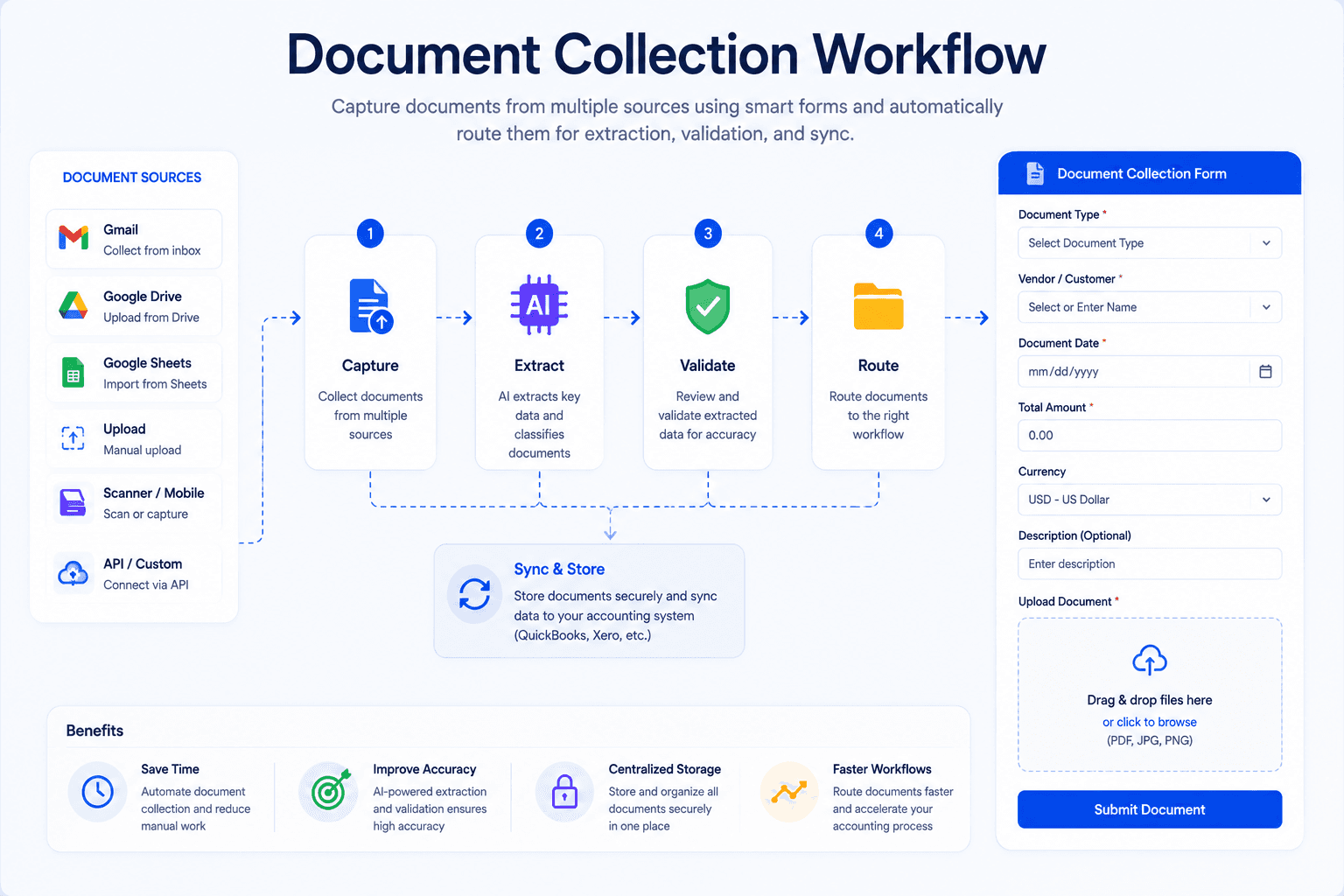
Centralized Document Collection
BillsDeck automatically collects:
- Purchase Orders
- Invoices
- Receipts
- Vendor Credits
- Quotes
- Delivery Documents
- Inspection Records
from email, uploads, portals, and shared folders.
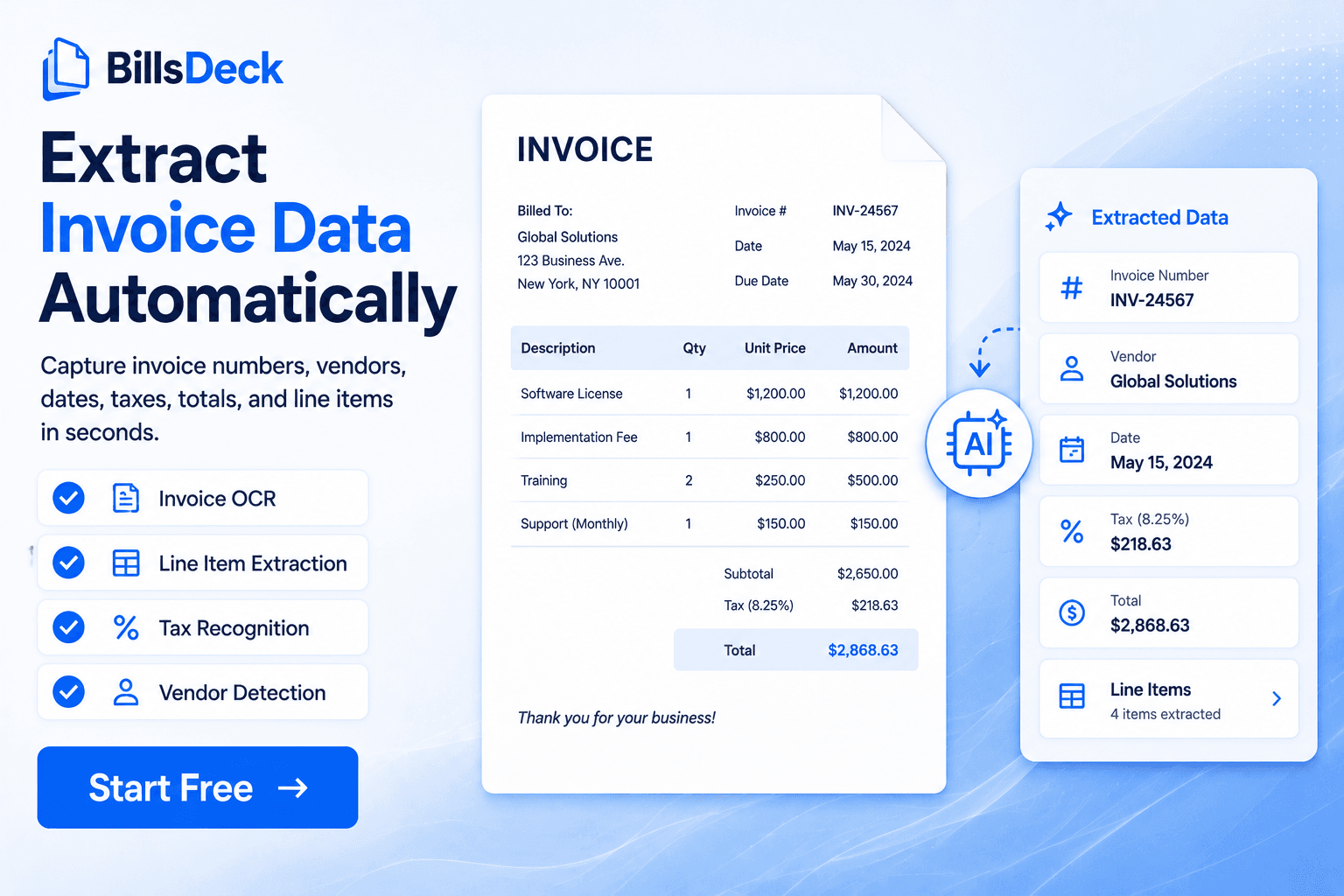
AI-Powered Data Extraction
BillsDeck extracts:
- Vendor details
- Invoice numbers
- Line items
- Quantities
- Prices
- Taxes
- PO references
without manual entry.
Automated 2-Way Matching
Match:
Purchase Order ↔ Invoice
Ideal for services and recurring purchases.
Automated 3-Way Matching
Match:
Purchase Order ↔ Goods Receipt ↔ Invoice
Automatically identify:
- Price variances
- Quantity mismatches
- Missing deliveries
- Duplicate invoices
before payment approval.
Automated 4-Way Matching
Match:
Purchase Order ↔ Receipt ↔ Invoice ↔ Inspection Record
Ideal for organizations requiring quality verification before payment.
Exception Workflows
BillsDeck automatically routes mismatches to the correct approver for resolution.
Accounting System Synchronization
After approval, BillsDeck syncs data to accounting platforms including:
- QuickBooks
- Xero
- Zoho Books
- ERP systems
- Custom integrations
This eliminates duplicate data entry and keeps financial records updated.
Best Practices for Successful 3-Way Matching
Standardize Purchase Orders
Ensure all purchases begin with approved POs.
Capture Receiving Data Promptly
Record deliveries immediately upon receipt.
Automate Invoice Extraction
Reduce manual keying errors through OCR and AI extraction.
Define Matching Tolerances
Allow small acceptable differences for:
- Quantity
- Freight
- Taxes
Create Exception Rules
Automate escalation paths for mismatches.
Integrate Procurement and Accounting
Eliminate disconnected systems that slow approvals.
Maintain Audit Trails
Keep complete document histories for compliance and audits.
Frequently Asked Questions
What is 3-way matching in accounts payable?
3-way matching is the process of comparing a purchase order, goods receipt, and supplier invoice before approving payment.
What is 3-way invoice matching?
It is the verification of invoice information against purchase orders and receiving records to ensure accuracy.
What is 2-way and 3-way matching in accounts payable?
2-way matching compares purchase orders and invoices, while 3-way matching additionally verifies goods receipt information.
What is 3-way matching in procurement?
It is a procurement control process used to confirm that ordered goods were delivered and invoiced correctly.
What is 2 way 3 way and 4 way matching?
- 2-Way: PO + Invoice
- 3-Way: PO + Receipt + Invoice
- 4-Way: PO + Receipt + Invoice + Inspection Report
Which ERP systems have built-in 3-way matching?
Common examples include SAP, Oracle NetSuite, Microsoft Dynamics 365, Sage Intacct, Acumatica, Epicor, Infor, and others.
Which platforms simplify 3-way matching in AP?
Modern AP automation platforms that combine document capture, workflow automation, OCR extraction, and accounting integrations significantly simplify 3-way matching.
Why is 3-way matching important?
It reduces fraud, prevents overpayments, improves compliance, and ensures invoices accurately reflect purchased and received goods.
Final Thoughts
As organizations scale, invoice verification becomes increasingly complex. Manual reviews are slow, error-prone, and difficult to audit.
That's why searches for terms such as "3 way matching in accounts payable," "what is 3 way matching," and "accounts payable 3 way matching" continue to grow.
A well-designed 3-way matching process helps organizations verify purchases, reduce risk, and maintain stronger financial controls. For businesses with more complex procurement requirements, 4-way matching adds another layer of protection through quality verification.
By combining document collection, AI-powered extraction, automated matching, exception management, and accounting synchronization, platforms like BillsDeck enable finance teams to automate 2-way, 3-way, and 4-way matching workflows while maintaining complete visibility from procurement through payment.